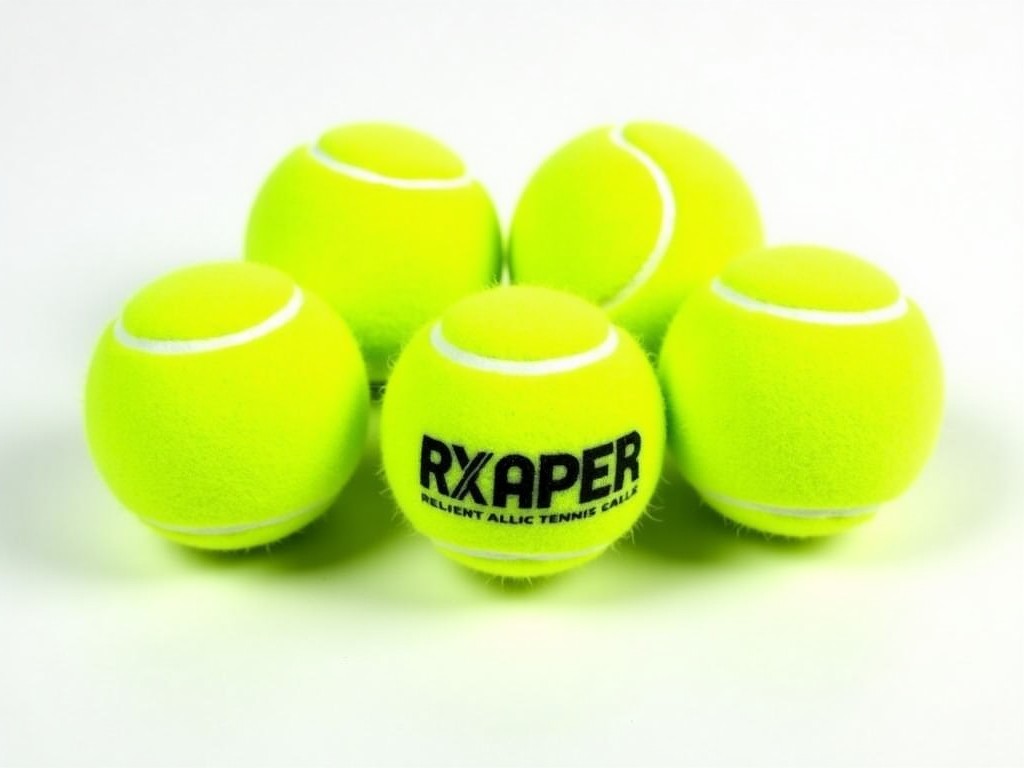
Custom Quicksand Beach Tennis Balls Manufacturer
Beach tennis played on loose, fine sand demands balls that maintain consistent bounce, resist sand ingress, and retain structural integrity after repeated impacts. The design focuses on core density,
Custom Quicksand Beach Tennis Balls
Beach tennis played on loose, fine sand demands balls that maintain consistent bounce, resist sand ingress, and retain structural integrity after repeated impacts. The design focuses on core density, felt permeability, and surface texture to meet these conditions.
Core Construction and Material Selection
The internal core is made from a blended natural‑rubber and synthetic‑isoprene compound, formulated to achieve a specific gravity between 0.94 and 0.98 g/cm³. This range provides the necessary low‑mass inertia for a lively bounce while limiting excessive sinking into sand.
A dual‑layer felt covering surrounds the core. The inner layer uses a mildew‑resistant polyester blend with a nominal thickness of 0.8 mm, while the outer layer consists of a tightly woven nylon‑felt with a pile height of 1.6 mm and a water‑absorption rate below 2 % after 30 minutes immersion.
Dimensional and Performance Specifications
| Parameter | Typical Range | Test Method |
|---|---|---|
| Diameter | 65.0 – 66.5 mm | Caliper measurement (ISO 5775‑1) |
| Weight | 56.0 – 60.0 g | Analytical balance (ASTM E617) |
| Rebound Height (drop 200 mm) | 115 – 125 cm | ASTM F1887 |
| Shore A Hardness (felt) | 45 – 55 | ASTM D2240 |
| Internal Pressure | 0.75 – 0.85 bar | Pressure gauge (ISO 8124‑1) |
Customization Options
- Diameter adjustments from 63 mm to 68 mm in 0.5 mm increments.
- Weight modulation via core density variation (± 2 g).
- Choice of felt composition: standard nylon‑felt, UV‑stabilized polyester‑felt, or sand‑repellent silicone‑coated felt.
- Surface color options matched to Pantone or RAL specifications, with optional logo pad‑printing (up to 3 colors).
- Pressure setting customizable between 0.6 bar and 1.0 bar for specific bounce characteristics.
Applications in Beach Tennis Environments
The low‑density core reduces the tendency of the ball to embed itself in loose sand, allowing players to maintain a predictable trajectory during rallies. The felt’s controlled permeability limits sand accumulation, preserving the ball’s surface friction and spin potential over extended play sessions.
These attributes are particularly valuable in tournament settings where court preparation time is limited and consistent ball behavior directly influences match fairness. Training facilities also benefit from reduced ball‑maintenance intervals, as the sand‑repellent felt decreases cleaning frequency.
Quality Assurance and Testing Philosophy
Each production lot undergoes dimensional verification on a statistical sample basis (AQL 0.65) for diameter and weight. Rebound performance is measured using a calibrated drop‑test rig, with results recorded against the specification limits outlined in the table above. Visual inspection of felt integrity and adhesion is performed under 10× magnification to detect delamination or pilling.
Environmental resistance is evaluated through accelerated UV exposure (ISO 4892‑2) and salt‑fog testing (ASTM B117) to ensure that material properties remain within tolerance after simulated seasonal use. All test data are retained for traceability and are available to customers upon request.
Ordering, Lead Times, and Support
Custom projects begin with a technical consultation to confirm dimensional targets, material selections, and any branding requirements. Following approval of a pre‑production sample, the standard production lead time ranges from 4 to 6 weeks, depending on order volume and customization complexity.


