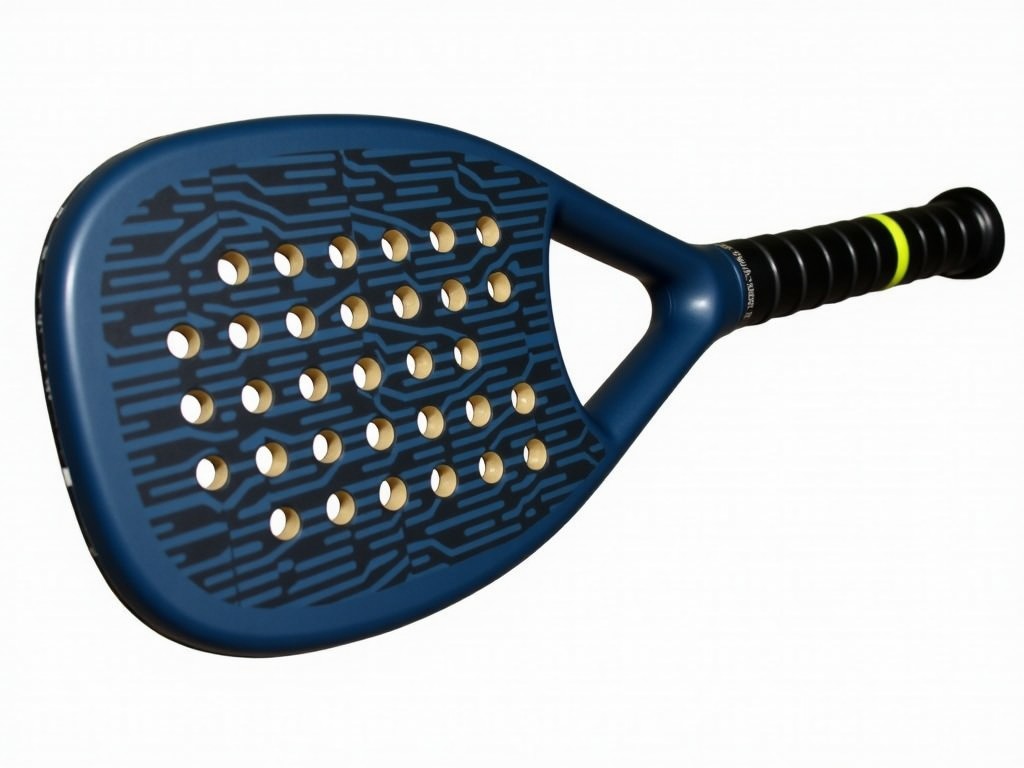
B2B Carbon Fiber Padel Racket Manufacturer
The racket is constructed from multiple layers of unidirectional carbon fiber prepreg, providing a high stiffness‑to‑weight ratio essential for rapid swing dynamics in padel. Each layer is oriented
B2B Carbon Fiber Padel Racket Manufacturer
Product Overview
The racket is constructed from multiple layers of unidirectional carbon fiber prepreg, providing a high stiffness‑to‑weight ratio essential for rapid swing dynamics in padel. Each layer is oriented to optimize torsional stability while maintaining a forgiving sweet spot for off‑center impacts. The design targets a balance point between 260 mm and 280 mm from the handle, delivering maneuverability without sacrificing power.
Material & Construction
Carbon fiber sheets are selected based on tensile modulus, typically ranging from 230 GPa to 280 GPa, and are impregnated with epoxy resin systems rated for a glass transition temperature above 120 °C.
The layup schedule incorporates a 0°/±45°/90° sequence across the frame, with additional reinforcement zones at the throat and head to resist impact‑induced delamination.
A thin polyurethane over‑wrap is applied to the striking surface to enhance abrasion resistance and provide a consistent feel.
Core material options include high‑density foam (density 45‑55 kg/m³) or honeycomb structures, selected according to desired vibration damping characteristics.
All materials are sourced with traceable batch numbers to support quality audits and material certification.
Manufacturing Process
During production, prepreg sheets are cut using CNC laser systems to ensure fiber alignment tolerance within ±0.5°. The layup is performed in a temperature‑controlled clean room to prevent contamination.
The assembled blank is then placed in a heated press at 180 °C under 150 psi for 90 minutes, achieving full cure of the epoxy matrix.
Post‑cure, the rackets undergo CNC machining to final dimensions, followed by surface polishing and application of the protective over‑wrap.
Performance Characteristics
Measured static weight ranges from 340 g to 360 g, with a tolerance of ±2 g, allowing precise matching to player preferences.
Swing weight, determined via pendulum method, falls between 250 and 280 kg·cm², providing a balance of maneuverability and power transfer.
Frame stiffness, assessed using three‑point bend testing, averages 62 RA with a standard deviation of 3 RA, indicating consistent response across the product line.
Vibration damping is quantified by logarithmic decrement; typical values range from 0.018 to 0.022, reducing player fatigue during extended play.
- Weight: 340‑360 g (±2 g)
- Balance point: 260‑280 mm from handle
- Swing weight: 250‑280 kg·cm²
- Stiffness: 60‑65 RA
- Damping coefficient: 0.018‑0.022
Customization Options
Clients can specify fiber orientation, resin system, and core geometry to align with performance targets or branding requirements.
Surface finishes, grip size, and cosmetic graphics are adjustable without altering structural integrity.
- Layup patterns: custom angle sequences (0°/±30°/±60°/90°)
- Resin types: standard epoxy, high‑temperature epoxy, toughened epoxy
- Core materials: PU foam densities 30‑60 kg/m³, Nomex honeycomb, aluminum honeycomb
- Grip circumferences: 100 mm, 106 mm, 112 mm (custom sizes available)
- Graphics: sublimated prints, embossed logos, matte or gloss UV coating
Applications
Padel facilities benefit from rackets that deliver consistent ball response, reducing variability in training drills and match play.
The high stiffness‑to‑weight ratio supports rapid volley exchanges, while the damping characteristics help mitigate joint stress during prolonged sessions.
Custom branding options enable clubs and distributors to offer differentiated product lines aligned with their market positioning.
- Training centers requiring uniform equipment for skill development
- Competitive clubs seeking performance‑matched rackets for team play
- Retail distributors looking for private‑label solutions with technical traceability
- OEM partners integrating rackets into multi‑sport equipment bundles
Quality Assurance
Each unit undergoes dimensional inspection using coordinate measuring machines, verifying length, width, and thickness within ±0.2 mm tolerances.
Non‑destructive testing includes ultrasonic C‑scan to detect internal delaminations or voids larger than 0.5 mm².
Final performance validation involves impact testing at 30 m/s, measuring coefficient of restitution and frame deflection to ensure compliance with specified stiffness and damping ranges.
Technical Specifications
Typical values are provided; exact figures can be tailored according to project requirements.
| Parameter | Value | Unit | Notes |
|---|---|---|---|
| Weight | 340‑360 | g | ±2 g tolerance |
| Balance point | 260‑280 | mm from handle | Adjustable |
| Swing weight | 250‑280 | kg·cm² | Pendulum method |
| Stiffness | 60‑65 | RA | Three‑point bend |
| Damping coefficient | 0.018‑0.022 | – | Logarithmic decrement |
| Core density (foam) | 45‑55 | kg/m³ | Optional honeycomb |
Frequently Asked Questions
Yes, length, width, and thickness can be adjusted within structural limits; custom molds are available upon request.
Desired weight range, balance point, core material, surface finish, and order volume help us prepare an accurate quote.
We perform dimensional checks, ultrasonic C‑scan, and impact testing as outlined in our quality assurance section.
Standard packaging includes individual foam sleeves and corrugated cartons; palletizing and moisture‑barrier options are offered for export.
Lead time ranges from 4 to 6 weeks after final design approval, depending on complexity and order size.
Contact Us
Our engineering team is ready to discuss your specific performance targets, customization needs, and volume requirements.
To initiate a technical consultation, please use the contact form or reach out directly via the provided channels.
Request Technical Consultation


