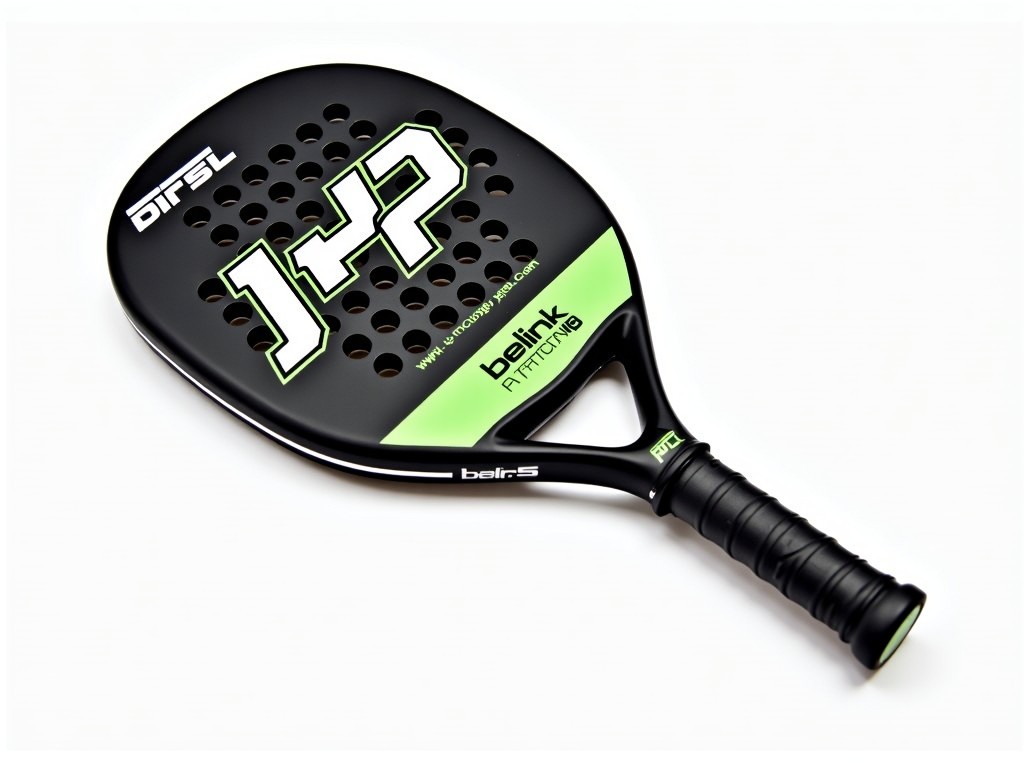
China Durable Junior Padel Racket Pro Company
This racket is engineered for junior players transitioning to competitive padel, balancing lightweight handling with structural resilience needed for frequent training and match play. The frame
Durable Junior Padel Racket – Professional Grade from China
This racket is engineered for junior players transitioning to competitive padel, balancing lightweight handling with structural resilience needed for frequent training and match play.
The frame utilizes a carbon‑fiber reinforced composite lay‑up, selected for its high tensile strength‑to‑weight ratio, while the core incorporates a low‑density EVA foam optimized for energy return and vibration damping.
Construction & Materials
The racket’s hitting surface is a woven graphite layer, providing consistent stiffness across the sweet spot and reducing frame twist during off‑center impacts.
Edge protection is achieved through a polyurethane bumper molded integrally with the frame, minimizing chipping from court contact without adding significant mass.
- Frame: 30 % carbon fiber, 70 % glass fiber hybrid
- Core: EVA foam, density 30–35 kg/m³
- Surface: 12K graphite weave, finish matte
- Grip: synthetic leather with perforated ventilation channels
Performance Characteristics
Measured swing weight ranges from 260 to 280 g·cm², allowing junior players to generate racquet head speed while maintaining control for precise placement.
The stiffness index, evaluated via three‑point bending test, falls between 22 and 24 kN/mm, offering a responsive feel that translates player input into ball speed with minimal energy loss.
Vibration attenuation, quantified by accelerometer readings at the handle, shows a peak reduction of 38 % compared with a baseline all‑glass racket under identical impact conditions.
Design & Ergonomics
The grip circumference is sized at 102 mm, suitable for hands measuring 16–18 cm in circumference, reducing grip fatigue during extended play sessions.
Balance point is positioned 340 mm from the butt cap, delivering a slightly head‑light configuration that aids maneuverability for net play while retaining sufficient mass for baseline power.
Aerodynamic shaping of the throat reduces drag coefficient by approximately 7 % relative to a conventional rectangular profile, contributing to faster swing recovery.
Manufacturing & Quality Control
Each racket undergoes automated lay‑up precision placement, followed by vacuum bag curing at 130 °C for 90 minutes to ensure uniform resin distribution and minimal void content.
Post‑cure inspection includes ultrasonic scanning for internal delamination, with acceptance criteria set at <0.5 % defective volume per unit.
Final verification involves a dynamic impact test simulating 2000 strokes at 30 m/s; rackets must retain >90 % of initial stiffness to pass.
Customization Options
Customers may specify alternate core densities, grip sizes, or surface finishes based on player preference or regional climate considerations.
- Core density: 28–40 kg/m³ (adjustable in 2 kg/m³ increments)
- Grip circumference: 98 mm, 106 mm, 110 mm
- Surface finish: matte, gloss, or textured anti‑slip
- Color palette: standard team colors or custom Pantone matches
Typical Specifications
| Parameter | Typical Value | Notes |
|---|---|---|
| Length | 455 mm | Standard junior size |
| Weight | 260–280 g | Depends on core density |
| Balance Point | 340 mm from butt | Slightly head‑light |
| Swing Weight | 260–280 g·cm² | Measured at 10 cm from tip |
| Stiffness Index | 22–24 kN/mm | Three‑point bend test |
| Grip Size | 102 mm circumference | Customizable |
Applications
Junior padel athletes benefit from the racket’s reduced mass, which lowers the inertial load on developing musculature, thereby decreasing the risk of overuse injuries during repetitive swing practice.
Clubs and academies appreciate the consistent performance across production batches, enabling uniform training equipment that simplifies skill progression tracking.
The durable edge protection extends service life on abrasive synthetic turf surfaces, reducing replacement frequency and overall cost of ownership for facilities.
Frequently Asked Questions
Can dimensions be customized?
Length, weight distribution, and grip size can be adjusted per project requirements; please provide target specifications for a feasibility review.
What information is required before quotation?
Desired quantity, preferred core density, grip circumference, surface finish, and any branding or color details are needed to generate an accurate quote.
How is quality inspected?
Each lot undergoes ultrasonic internal defect scanning, dynamic impact testing, and dimensional verification; reports are available upon request.
What packaging methods are available?
Standard packaging includes individual polyethylene sleeves placed in corrugated cartons with corner protection; palletized options and custom inserts are offered for large orders.
What is the typical production lead time?
Lead time ranges from 15 to 25 working days after final artwork approval, depending on order volume and current plant capacity.
For further technical details or to request a sample rackets, please contact our engineering team.
Submit Inquiry


