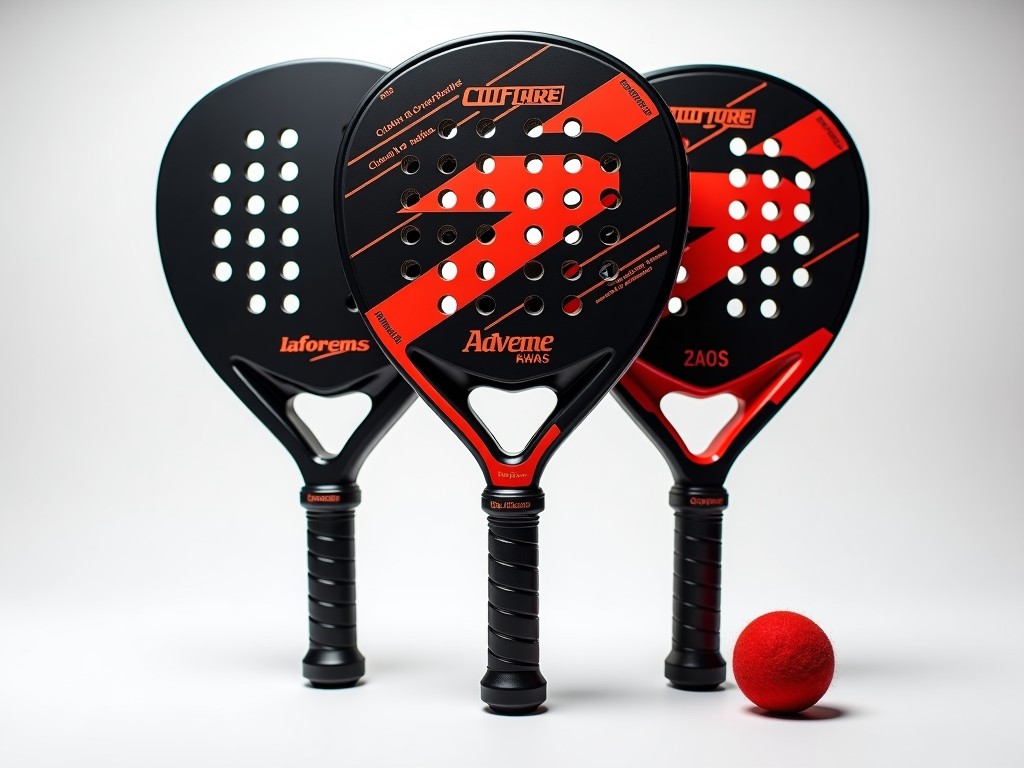
Custom Advanced Adjustable Padel Racket Company
This page describes the engineering approach behind fully customizable padel rackets that integrate an adjustable stiffness system, allowing players to modify flex characteristics without changing
Custom Advanced Adjustable Padel Racket Company
This page describes the engineering approach behind fully customizable padel rackets that integrate an adjustable stiffness system, allowing players to modify flex characteristics without changing the frame geometry. The focus is on material selection, adjustment mechanisms, and validation methods that support consistent performance across skill levels.
Overview
The core concept centers on a modular bridge located in the throat area, where interchangeable inserts alter the effective bending modulus. By varying insert thickness and composite lay‑up, the racket’s natural frequency can be shifted within a range of 150 Hz to 210 Hz, measured using a modal impact hammer. This adjustability enables fine‑tuning for power‑oriented or control‑oriented playstyles without requiring a new mold.
Key Technical Characteristics
Adjustment is achieved through a set of three cartridge options: low‑modulus (E≈30 GPa), medium‑modulus (E≈45 GPa), and high‑modulus (E≈60 GPa) carbon‑epoxy tubes. Each cartridge is locked via a torque‑controlled set screw (M3, 0.8 Nm) to prevent migration during play. The frame itself uses a high‑strength aramid‑carbon hybrid weave with a nominal tensile strength of 4.2 GPa, verified by ASTM D3039 testing.
| Parameter | Typical Range | Adjustment Step |
|---|---|---|
| Natural frequency (first bending mode) | 150 Hz – 210 Hz | ≈20 Hz per cartridge change |
| Static stiffness (k) | 180 N/mm – 260 N/mm | ≈25 N/mm per step |
| Weight (unstrung) | 340 g – 380 g | ±5 g via insert mass |
Customization Options
- Cartridge stiffness: selectable low, medium, high, or custom lay‑up upon request
- Grip size: standard (L2), extended (L3), or reduced (L1) with optional over‑wrap thickness
- Frame length: 455 mm – 470 mm adjustable in 2 mm increments via movable butt cap
- Surface finish: matte UV‑cured coating, glossy poly‑urethane, or textured sand‑grip
- Color options: standard palette (black, white, navy) plus Pantone‑matched custom hues
Materials and Construction
The frame utilizes a bidirectional aramid‑carbon hybrid fabric (60 % aramid, 40 % carbon) impregnated with a toughened epoxy resin system, providing impact resistance above 12 kJ/m² as measured by ISO 179‑1. Adjustment cartridges are fabricated from unidirectional carbon prepreg with varying fiber volume fractions (55 %–65 %) to achieve the targeted modulus range. All bonding surfaces receive a plasma‑treated primer to ensure shear strength exceeding 22 MPa.
Manufacturing Process
Production begins with CNC‑cut foam mandrels that define the internal cavity shape. Fabric plies are laid up by hand using a laser‑projected guide to maintain ply orientation tolerance within ±2°. After vacuum bagging and autoclave cure at 180 °C for 90 minutes, the frame undergoes demolding, followed by precision milling of the throat recess to accommodate the cartridge interface. Cartridges are produced separately, then inserted and torqued to specification before final grip installation and surface coating.
Quality Assurance
Each racket undergoes three inspection stages: (1) dimensional verification of critical features (throat width, grip length) using a CMM with ±0.02 mm repeatability; (2) modal analysis to confirm the selected cartridge yields the target natural frequency within ±3 Hz; (3) impact durability testing where 500 shots at 35 m/s are delivered to the sweet spot, with no delamination observed per ASTM D3410. A batch‑level statistical process control chart tracks weight and stiffness, triggering investigation if values exceed 2σ from the mean.
Applications in Padel Sports
Adjustable stiffness benefits players who need to adapt to varying court conditions—such as slower indoor surfaces versus faster outdoor courts—without acquiring multiple rackets. Coaches can use the system to tailor equipment for developing athletes, gradually increasing stiffness as technique improves. Competitive players report reduced arm fatigue when switching from a power‑oriented setup (low stiffness) to a control‑oriented setup (high stiffness) during long matches, attributed to altered vibration transmission characteristics.
Comparison Table: Adjustable vs Fixed Rackets
| Attribute | Adjustable System | Conventional Fixed Racket |
|---|---|---|
| Stiffness range | 180 N/mm – 260 N/mm (3‑step) | Fixed value (typically 210 N/mm) |
| Weight variability | ±5 g via cartridge mass | Fixed |
| Tool‑free adjustment | Yes (set screw, 0.8 Nm) | No |
| Inventory complexity | One frame, multiple cartridges | Multiple frames per stiffness |
Frequently Asked Questions
- Can the adjustment be performed during play? The set screw requires a 2 mm hex key; adjustment is intended between sets or during breaks to avoid altering grip tension mid‑point.
- What information is required before quotation? Desired stiffness range, grip size, frame length, finish, and any branding or color specifications.
- Are the cartridges interchangeable between different frame models? Cartridge dimensions are model‑specific; cross‑compatibility is not guaranteed without validation.
- How is quality inspected for the adjustable mechanism? Torque verification, axial play measurement (<0.1 mm), and cyclic load testing (10 000 insert‑remove cycles) are performed on a sampling basis.
- What packaging methods protect the rackets for export? Each unit is placed in a form‑fit foam insert inside a double‑wall corrugated carton, with corner boards and moisture‑barrier bags for sea freight.
Request a Quote
To begin a custom configuration, provide your performance targets and any branding requirements. Our engineering team will review the inputs, propose a cartridge suite, and deliver a detailed quotation with lead‑time estimates. Start your inquiry.


