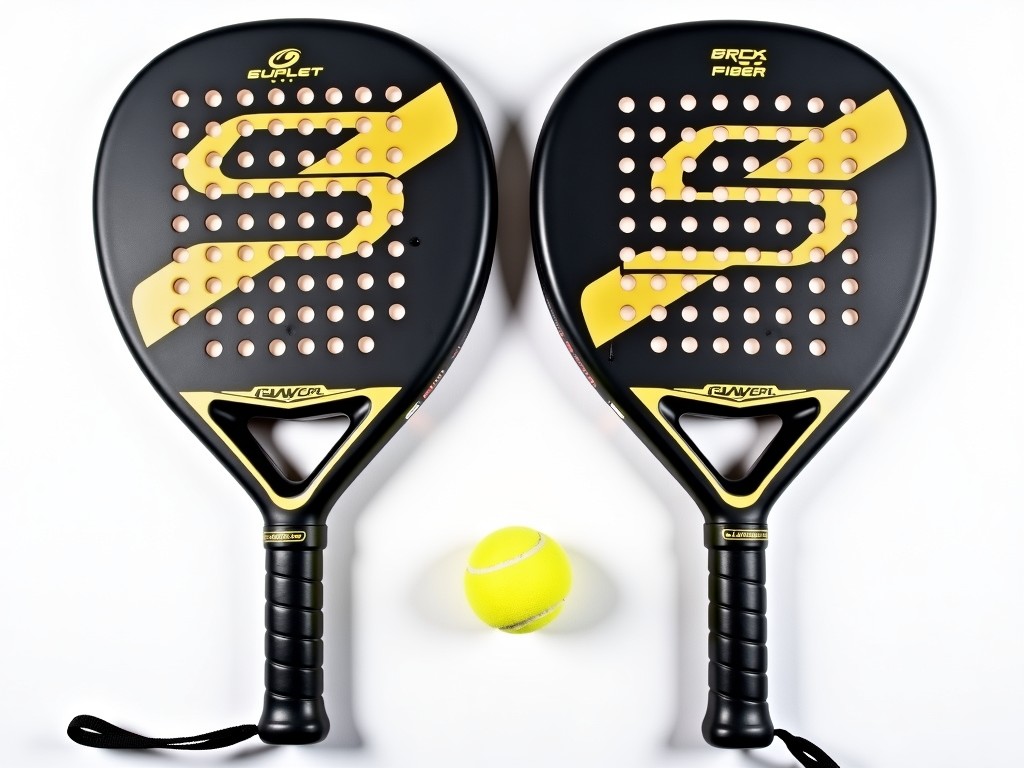
Custom Carbon Fiber Padel Racket Manufacturer
Padel rackets experience repeated impact loads, torsional twist, and vibration during play. Carbon fiber provides a high specific modulus and tensile strength, allowing designers to achieve target
Custom Carbon Fiber Padel Racket Manufacturer
Padel rackets experience repeated impact loads, torsional twist, and vibration during play. Carbon fiber provides a high specific modulus and tensile strength, allowing designers to achieve target stiffness while keeping mass low. The following sections detail how material selection, layup strategy, and process controls translate into measurable performance attributes for a custom racket.
Material Composition and Layup
A typical racket uses a prepreg system consisting of aerospace‑grade carbon fiber tows (7 µm diameter) impregnated with an epoxy resin system rated for a glass transition temperature above 120 °C. The fiber volume fraction is maintained between 55 % and 60 % to optimize stiffness‑to‑weight ratio. Layup varies by zone: the hoop employs a 0°/90° quasi‑isotropic stack for impact resistance, while the throat uses a ±45° bias layer to enhance torsional rigidity.
Surface finish is achieved with a 3K plain weave outer layer, providing a predictable wear pattern and facilitating grip adhesion. Resin content is controlled via vacuum bagging to keep void content below 1 %, which directly influences fatigue life under repeated impact cycles.
Customization Parameters
Geometry, mass distribution, and stiffness are the primary variables adjusted to match player biomechanics and playing style. Each parameter is defined within a range that preserves structural integrity while offering perceptible change in feel.
| Parameter | Adjustable Range | Effect on Play |
|---|---|---|
| Overall Length | 455 mm – 470 mm | Alters swing weight and reach |
| Head Width | 260 mm – 280 mm | Impacts sweet spot size and power |
| Mass (unstrung) | 340 g – 380 g | Influences maneuverability and stability |
| Balance Point | 260 mm – 290 mm from handle | Shifts feeling between head‑heavy and handle‑heavy |
| Flexural Modulus (longitudinal) | 70 GPa – 85 GPa | Controls power transmission vs. vibration damping |
Grip circumference and surface texture are also selectable. Standard grip sizes range from 100 mm to 110 mm circumference, with options for perforated or tacky overgrips to adjust moisture handling.
Performance Characteristics
The longitudinal modulus of the carbon fiber/epoxy laminate determines how much kinetic energy is transferred to the ball upon impact. A higher modulus yields greater ball exit speed, while a lower modulus increases dwell time, enhancing control. Damping capacity, derived from the epoxy’s loss factor, reduces vibration transmitted to the player’s wrist and elbow, lowering the risk of repetitive strain.
Tensile strength of the hoop laminate, typically above 3.5 GPa, ensures resistance to crack initiation from off‑center impacts. Fatigue testing at 2 Hz impact loads shows less than 5 % stiffness degradation after 10⁵ cycles when void content remains under 1 % and fiber alignment is within ±2 ° of design orientation.
Manufacturing Process
Prepreg sheets are cut to shape using a CNC laser with positional accuracy ±0.1 mm. The layup is performed on a temperature‑controlled mold (20 °C ± 2 °C) to maintain resin tackiness. Vacuum bagging at 0.8 bar removes entrapped air before the part moves to a heated press.
Cure cycle follows a ramp of 2 °C/min to 180 °C, hold for 90 minutes, then cool at 3 °C/min. Post‑cure at 200 °C for 60 minutes completes the resin cross‑link, achieving the target glass transition temperature. Final machining of the handle and grip groove is performed with diamond‑coated tools to avoid fiber pull‑out.
Quality Assurance
Each racket undergoes three inspection stages: dimensional verification, mass measurement, and flexural testing. Length, width, and thickness are measured with a coordinate measuring machine; tolerances are ±0.5 mm for length and ±0.2 mm for thickness. Mass is recorded to the nearest 0.1 g, with batch limits set at ±5 g from the target.
Flexural stiffness is determined by a three‑point bend test at a span of 200 mm; the resulting modulus must fall within ±4 % of the design value. Non‑destructive ultrasonic scanning checks for delamination or voids larger than 0.5 mm². Only parts passing all criteria proceed to final packaging.
Applications in Padel
Competitive padel demands consistent feel across thousands of shots. A racket with predictable stiffness and low vibration reduces player fatigue, allowing sustained performance during long matches. The ability to fine‑tune balance and mass lets athletes match the racket to their swing tempo, improving shot placement and reducing unforced errors.
Recreational players benefit from the durability of carbon fiber, which resists cracking from occasional ground contact or wall impacts. The material’s corrosion resistance ensures longevity in humid climates where traditional wood or aluminum frames may degrade.
Frequently Asked Questions
Q: Can the racket length be adjusted beyond the standard range?
A: Lengths outside 455 mm–470 mm require a redesign of the mold and may affect structural integrity; such requests are evaluated case‑by‑case.
Q: What information is needed to generate a quotation?
A: Desired weight, balance point, head width, grip size, and any cosmetic preferences (color, finish) are sufficient for an initial quote.
Q: Which resin systems are available?
A: Standard epoxy (Tg ≈ 130 °C) and high‑temperature epoxy (Tg ≈ 180 °C) are offered; alternative resins can be sourced upon request.
Q: How is quality inspected before shipment?
A: Dimensional check, mass verification, flexural modulus test, and ultrasonic C‑scan are performed on each unit.
Q: What packaging options protect the rackets during transit?
A: Each racket is placed in a low‑density polyethylene sleeve, then inserted into a double‑wall corrugated carton with corner protectors and shock‑absorbing inserts.
Q: What is the typical lead time for a custom order?
A: Production lead time ranges from 3 to 4 weeks after final design approval, depending on order complexity and current capacity.
Get a Quote
To discuss your specific performance targets and receive a detailed proposal, please reach out via our contact form. Provide the desired specifications outlined above, and our engineering team will respond with feasibility feedback, cost estimate, and projected timeline.


