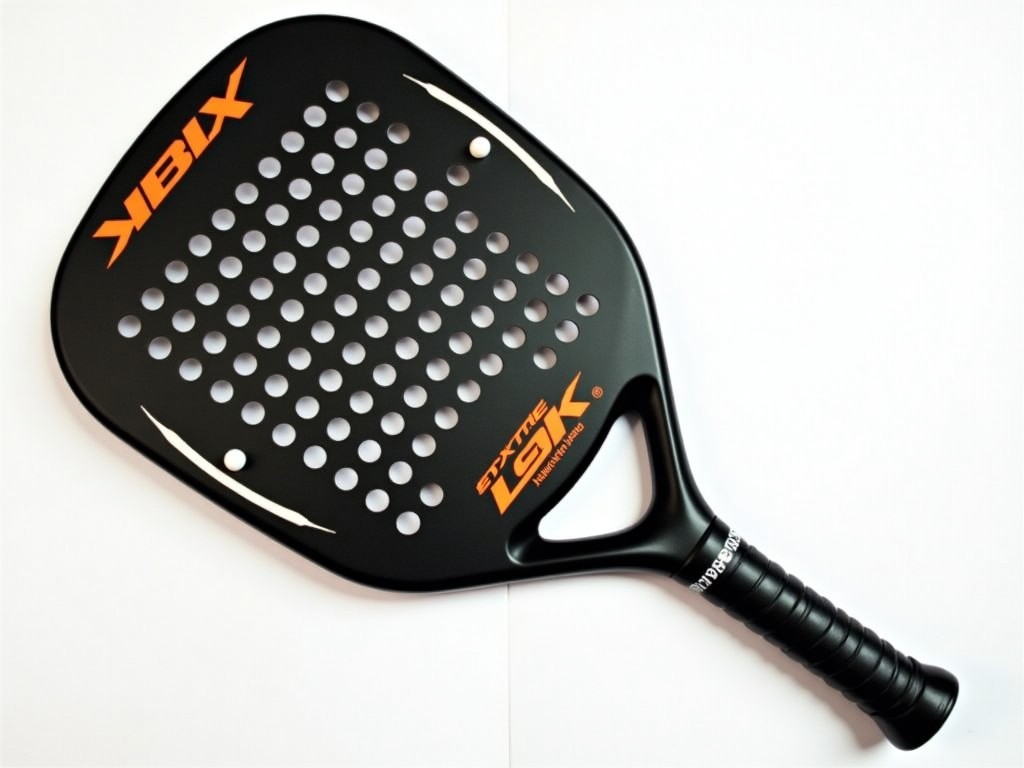
Custom Carbon Fibre Padel Rackets 12K Manufacturer
A 12k carbon fibre tow contains twelve thousand individual filaments per bundle, providing a high filament count that enables thin, uniform laminates with consistent mechanical properties. This tow
Custom Carbon Fibre Padel Rackets 12k Manufacturer
A 12k carbon fibre tow contains twelve thousand individual filaments per bundle, providing a high filament count that enables thin, uniform laminates with consistent mechanical properties. This tow size is commonly selected for sports equipment where a balance of tensile strength (≈5.5 GPa) and modulus (≈230 GPa) is required to achieve lightweight stiffness.
The resin system typically used is an epoxy formulated for a glass transition temperature (Tg) of 130 °C and a mixed viscosity suitable for vacuum bagging or autoclave processing. The cured laminate exhibits a interlaminar shear strength of approximately 80 MPa, contributing to impact resistance and fatigue life under repeated loading cycles typical in padel play.
Racket weight is controlled by adjusting the number of plies and resin content, resulting in a typical range of 340 g to 380 g for adult models. Balance point, measured from the butt end of the handle, usually falls between 260 mm and 290 mm, allowing designers to tune swing weight for either maneuverability or power.
| Parameter | Typical Value | Note |
|---|---|---|
| Weight (unstrung) | 340‑380 g | Depends on ply count |
| Balance point | 260‑290 mm from butt | Adjustable via weight distribution |
| Swing weight | 260‑300 kg·cm² | Measured at 100 mm from butt |
| Flexural modulus | ≈230 GPa | Longitudinal direction |
| Thickness (frame) | 18‑22 mm | Varies with geometry |
Customization begins with geometry selection: round, diamond, or teardrop head shapes each alter the sweet spot location and aerodynamic drag. Weight distribution can be shifted toward the head for increased power, toward the handle for better control, or kept even for a balanced feel. Grip circumference is offered in three standard sizes (small ≈ 100 mm, medium ≈ 106 mm, large ≈ 112 mm) with optional over‑grip layers.
Surface finish options include a matte polyurethane coating for reduced glare or a high‑gloss UV‑cured clear coat for enhanced color depth. Paint systems are water‑based pigments with a cured hardness of 2H, allowing for custom team logos or gradients without compromising the underlying laminate integrity.
Manufacturing relies on prepreg tapes where the 12k carbon fibre is pre‑impregnated with epoxy resin. The tapes are laid up on a CNC‑cut mandrel following a defined ply schedule, then vacuum‑bagged and cured in an autoclave at 125 °C under 2 bar pressure for 90 minutes. After demolding, the rackets undergo CNC trimming to final dimensions and edge reinforcement with a Kevlar‑filled strip to improve impact tolerance.
Quality assurance starts with incoming material verification: fibre areal weight (±2 %), resin content (±1 %). Each finished racket is weighed (±2 g) and measured for balance point (±5 mm). A C‑scan ultrasonic inspection checks for delamination or voids larger than 0.5 mm². Finally, a three‑point bend test validates that the flexural stiffness remains within ±5 % of the target value.
Padel players benefit from the high specific stiffness of 12k carbon fibre, which translates to greater ball speed for a given swing effort while keeping the frame light enough for quick wrist action. The damping characteristics of the epoxy‑carbon system reduce vibration transmission to the forearm, lowering the risk of overuse injuries during prolonged sessions. Additionally, the impact‑resistant laminate withstands repeated contact with the court walls and glass without surface cracking.
Frequently Asked Questions
- Can dimensions be customized? Yes, head length, width, and throat geometry can be adjusted within structural limits to suit player preference.
- What information is required before quotation? Desired weight range, balance point, grip size, shape, finish, and any branding artwork.
- What materials are available? Standard 12k carbon fibre prepreg; alternative tow sizes (6k, 24k) and hybrid fibres (glass‑carbon) are offered upon request.
- How is quality inspected? Weight, balance, dimensional checks, ultrasonic C‑scan, and flexural testing as described.
- What packaging methods are available? Individual rackets placed in corrugated sleeves with corner protectors, packed in cartons of 6 or 12 units with palletization for export.
- How are export shipments protected? Cartons are sealed with moisture‑resistant tape and strapped to pallets; optional foam edge guards can be added.
- What is the typical production lead time? 4‑6 weeks after final design approval, depending on order volume and tooling availability.
- How are samples arranged? Sample rackets are produced using the same production process and shipped via express courier upon receipt of a signed NDA.
To discuss your specific performance targets, request a detailed technical datasheet, or arrange a prototype sample, please use the contact link below.
Request Quote & Technical Data


