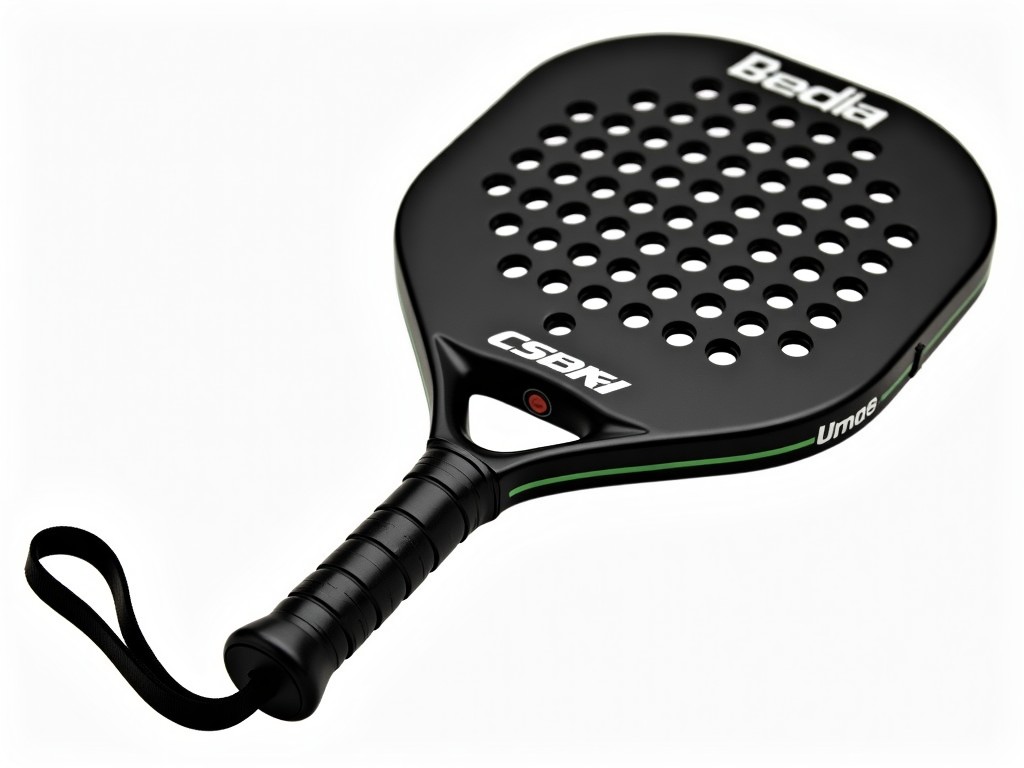
Custom Carbon Padel Racket Exporter
This section outlines the engineering considerations for producing carbon‑fiber padel rackets tailored to specific performance targets, including weight distribution, stiffness, and impact
Custom Carbon Padel Racket Exporter
This section outlines the engineering considerations for producing carbon‑fiber padel rackets tailored to specific performance targets, including weight distribution, stiffness, and impact resistance.
Technical Specification Overview
Key parameters that define a padel racket’s playing characteristics are frame mass, balance point, flexural modulus, and surface texture. These values are adjusted through lay‑up design and resin selection.
- Frame mass: typically 340‑380 g, adjustable in 5 g increments.
- Balance point: measured from handle end, ranging 260‑290 mm (head‑light to head‑heavy).
- Flexural modulus of carbon lay‑up: 70‑120 GPa depending on fiber orientation.
- Impact resistance: measured via drop‑test, target >150 J without delamination.
Material Options and Lay‑up Configurations
Carbon fiber types (3K, 12K, uni‑directional) and resin systems (epoxy, vinyl ester) influence stiffness, weight, and vibration damping. Hybrid lay‑ups combine layers to tune specific zones.
| Parameter | Typical Range | Adjustment Method |
|---|---|---|
| Frame mass | 340‑380 g | Add/remove reinforcement plies |
| Balance point | 260‑290 mm | Shift weight via tip or handle inserts |
| Flexural modulus | 70‑120 GPa | Vary fiber angle and layer count |
| Surface roughness (Ra) | 2‑6 µm | Finish sanding or coating thickness |
Customization Choices
Buyers can specify geometry, grip size, and cosmetic finish. Each choice influences swing weight and player comfort.
- Head shape: diamond, teardrop, or round – affects sweet spot location.
- Grip circumference: 3.5‑4.5 in, adjustable with over‑grip layers.
- Paint system: matte, gloss, or UV‑resistant clear coat – influences surface friction.
- Logo integration: laser‑etched or sublimated, thickness <0.1 mm.
Applications in Padel Sports
The racket’s stiffness and mass distribution determine power transfer, control, and vibration attenuation—critical for competitive play and injury prevention.
For baseline players, a head‑heavy balance (≈285 mm) increases swing momentum; for net players, a head‑light configuration (≈260 mm) improves maneuverability.
Custom vibration‑damping layers can reduce peak accelerations transmitted to the wrist, lowering fatigue during extended matches.
Quality Assurance Philosophy
Inspection focuses on dimensional tolerances, fiber alignment, and resin cure uniformity. Non‑destructive methods verify internal integrity before shipment.
- Laser scanning of frame profile: tolerance ±0.2 mm.
- Ultrasonic C‑scan for delamination detection: acceptance <0.5 mm² defect area.
- Mass measurement: precision balance ±0.1 g.
- Flexural test: three‑point bend, target modulus within ±5 % of design.
Packaging and Export Protection
Rackets are placed in individual PE foam sleeves, then stacked in corrugated cartons with corner guards. Each pallet is strapped and shock‑monitored.
- Inner sleeve thickness: 5 mm PE foam.
- Carton burst strength: >200 psi.
- Pallet load limit: 800 kg static.
- Shock indicator threshold: 50 g.
Frequently Asked Questions
Can dimensions be customized?
Yes, frame length, width, and profile depth are adjusted per drawing; tolerances are held to ±0.3 mm.
What information is required before quotation?
Target weight, balance point, preferred flex modulus, grip size, and any cosmetic specifications (color, logo).
What materials are available?
Carbon fiber fabrics (3K, 12K, UD), epoxy or vinyl‑ester resins, and optional aramid or basalt hybrid layers.
How is quality inspected?
Dimensional laser scan, ultrasonic C‑scan, mass measurement, and three‑point flexural test as outlined above.
What packaging methods are available?
Individual foam sleeve, corrugated carton with corner guards, palletized with strapping and shock indicators.
How are export shipments protected?
Cartons are stacked on ISO‑standard pallets, stretch‑wrapped, and labeled with handling instructions; shock indicators monitor transit.
What is the typical production lead time?
Lead time varies with order complexity; standard rackets ship within 4‑6 weeks after design approval.
How are samples arranged?
Sample units are produced using the same lay‑up schedule as production and shipped via express courier with tracking.


