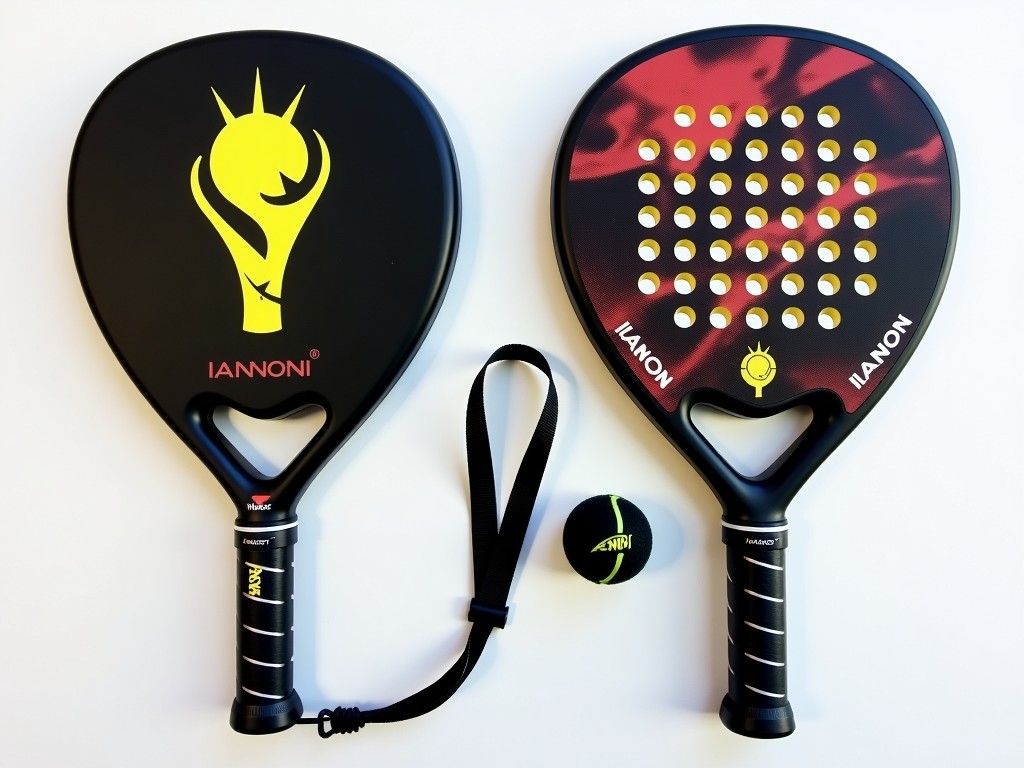
Custom Ianoni Padel Racket Top Supplier
The racket top, also known as the frame or head, determines stiffness, weight distribution, and impact response in a padel racket. Customizing this component allows manufacturers to tune performance
Custom IANONI Padel Racket Top Supplier
The racket top, also known as the frame or head, determines stiffness, weight distribution, and impact response in a padel racket. Customizing this component allows manufacturers to tune performance attributes such as swing speed, power output, and vibration damping to match player preferences and playing conditions. This page outlines the technical considerations, material options, and quality controls involved in supplying custom IANONI padel racket tops.
Material Composition and Mechanical Properties
Typical racket tops use a laminate of carbon fiber reinforced polymer (CFRP) layers oriented at 0°, ±45°, and 90° to balance axial stiffness and torsional resistance. The carbon fiber tensile modulus ranges from 230 to 400 GPa depending on fiber grade, while the epoxy matrix contributes a shear modulus of approximately 3 GPa. Density of the cured laminate falls between 1.45 and 1.60 g/cm³, influencing overall racket weight.
For increased damping, a thin interlayer of thermoplastic polyurethane (TPU) or viscoelastic foam can be added, raising the loss factor by 0.02–0.05 without significantly altering stiffness. Graphene nanoplatelets dispersed in the resin at 0.1–0.5 wt % can improve interlaminar shear strength by up to 15 %.
Customization Options
- Overall length: 455 mm to 475 mm (adjustable in 2 mm increments)
- Weight balance point: 260 mm to 290 mm from the butt cap (affects head‑heavy vs head‑light feel)
- Flexural stiffness (EI): 1.8 N·m² to 3.2 N·m² (measured at 100 mm span)
- Grip size circumference: 100 mm to 110 mm (customizable via overwrap thickness)
- Surface finish: matte, gloss, or textured sand‑in‑resin for enhanced spin
Manufacturing Process Overview
Pre‑impregnated carbon fiber tapes are cut to length and laid up on a CNC‑milled aluminum mold that mirrors the final racket top geometry. The layup follows a predefined stacking sequence to achieve target stiffness and weight distribution. After layup, the part undergoes vacuum bagging and is cured in an autoclave at 120–130 °C under 0.8 MPa pressure for 90 minutes.
Post‑cure, the component is demolded, excess flash is removed by CNC milling with a tolerance of ±0.1 mm on critical features such as the throat width and string hole locations. A final surface treatment—either UV‑cured clear coat or sand‑in‑resin texture—is applied before inspection.
Quality Assurance and Inspection Criteria
Each racket top is inspected for dimensional conformity using a coordinate measuring machine (CMM). Key dimensions—overall length, width at the throat, and string hole pitch—must remain within ±0.5 mm of the design nominal. Weight is verified on a precision scale with a tolerance of ±2 g.
Flexural testing is performed on a three‑point bend rig at a span of 150 mm; the load‑deflection curve must yield an stiffness value within the agreed range (±5 %). Impact resistance is evaluated by dropping a 20 mm steel sphere from 0.5 m onto the frame; no visible cracking or delamination is permitted.
Ultrasonic C‑scan scans the laminate for internal voids; acceptance criterion is less than 0.5 % void area per 100 mm². All inspection results are recorded in a traceable batch record linked to the specific customer order.
Typical Applications in Padel Equipment
The racket top governs how energy transfers from the player’s swing to the ball. A higher stiffness top yields greater ball exit speed but increases transmitted vibration, which may affect player comfort over long matches. Conversely, a more flexible top dampens vibration, reducing arm fatigue but slightly lowering power output.
By adjusting the layup angle distribution and incorporating viscoelastic interlayers, suppliers can tailor the top’s frequency response to suppress detrimental modes around 150–250 Hz, a range linked to elbow strain. This enables OEMs to offer rackets optimized for specific player profiles—aggressive baseliners requiring power, or control‑oriented players prioritizing feel and stability.
Specification Table
| Parameter | Standard Range | Customizable Range | Unit |
|---|---|---|---|
| Length | 460 ± 2 | 455 – 475 | mm |
| Weight | 340 ± 5 | 320 – 360 | g |
| Flexural Stiffness (EI) | 2.2 ± 0.2 | 1.8 – 3.2 | N·m² |
| Balance Point (from butt) | 275 ± 3 | 260 – 290 | mm |
| Surface Roughness (Ra) | 0.8 ± 0.2 | 0.4 – 1.5 | µm |
Frequently Asked Questions
Can dimensions be customized beyond the listed ranges? Yes, special lengths up to 485 mm or weight reductions below 300 g are feasible upon engineering review; additional tooling may be required.
What information is needed before quotation? Required inputs include target weight, balance point, desired stiffness (or flex rating), preferred fiber type, and any surface finish specifications.
Which material options are available for the interlayer? Standard options are thermoplastic polyurethane (TPU) films of 0.1–0.3 mm thickness and viscoelastic foam strips; custom polymer blends can be developed.
How is quality inspected for each batch? Every lot undergoes CMM dimensional checks, weight verification, flexural testing, impact testing, and ultrasonic C‑scan as described above.
What packaging methods protect the racket tops during transit? Parts are placed in individual anti‑static pouches, then stacked in corrugated cartons with corner protectors and shock‑absorbing inserts; palletized shipments use stretch film and edge boards.
Contact for Custom Solutions
To discuss your specific performance targets, material preferences, or production volumes, please reach out to our engineering team. We will review your requirements, propose a layup schedule, and provide a detailed quotation with lead times.


