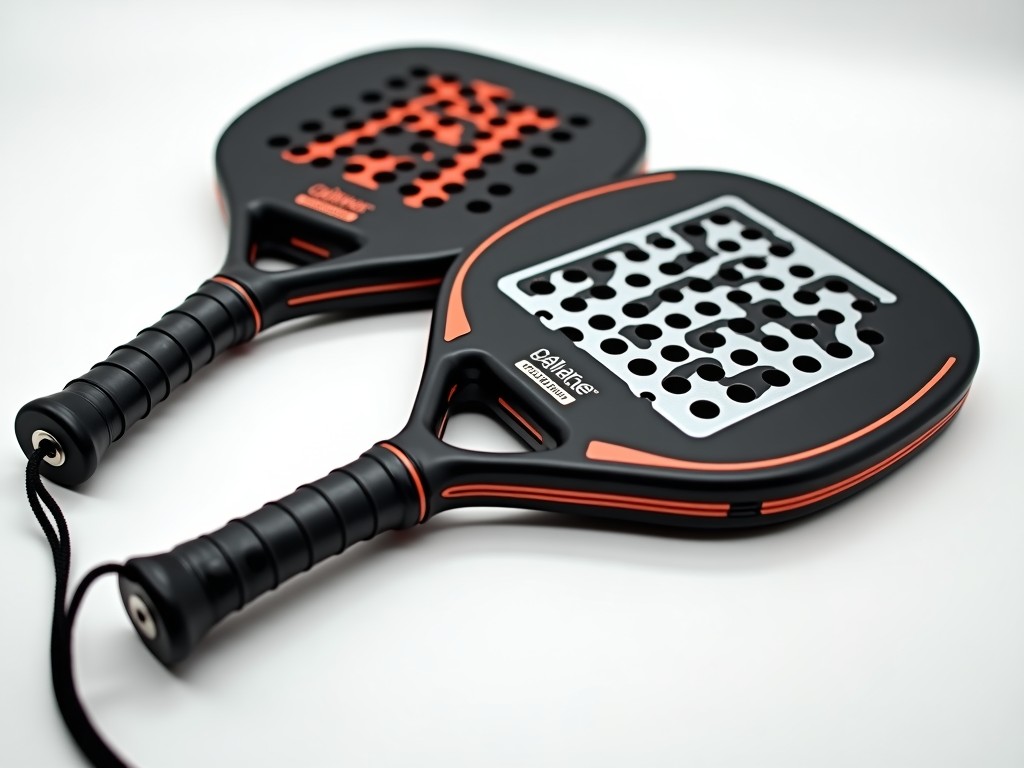
Custom Lightweight Low Balance Padel Racket Factory
A padel racket’s swing speed and control are governed by its mass distribution and total weight. Reducing frame mass while shifting the balance point toward the handle improves maneuverability for
Custom Lightweight Low Balance Padel Racket – Factory Production
A padel racket’s swing speed and control are governed by its mass distribution and total weight. Reducing frame mass while shifting the balance point toward the handle improves maneuverability for defensive volleys and rapid net play. This page explains how our factory engineers achieve those targets through material selection, layup geometry, and precise balance tuning.
Engineering Overview: Lightweight Construction and Balance Point
The target weight range for a competitive lightweight racket is 340–360 g, measured with strings and grip installed. A low balance point is defined as the distance from the butt cap to the center of mass falling between 200 mm and 210 mm. These values translate to a swing weight reduction of approximately 15 % compared with standard 370 g, 230 mm balance rackets.
Achieving both low mass and low balance requires a high‑modulus carbon fiber shell paired with a low‑density foam core. The shell carries bending loads while the core contributes minimally to overall inertia.
Material Selection: Carbon Fiber Layup and Core Foam
We use IM7 carbon fiber (tensile modulus ~ 200 GPa) in a quasi‑isotropic layup to maximize stiffness per unit weight. The core is a closed‑cell EVA foam with density 30 kg/m³, providing sufficient shear stiffness while adding negligible mass.
- Carbon fiber layers: 12 plies, 0°/±45°/90° orientation
- Core thickness: 18 mm (±0.2 mm)
- Surface finish: matte UV‑cured coating, 15 µm thickness
Balance Point Tuning: Achieving Low Balance for Maneuverability
Balance is adjusted by varying the thickness of the carbon fiber layers near the head versus the handle. Adding 0.1 mm of extra material in the handle region shifts the center of mass toward the grip by roughly 1.2 mm per layer.
We perform iterative finite‑element simulations to predict the resulting balance point before tooling, reducing trial‑and‑error cycles.
Final verification uses a precision pendulum rig with ±0.5 mm repeatability.
Customization Capabilities: Geometry, Weight, Grip, Surface Finish
Each racket is built to order, allowing independent adjustment of four primary parameters:
- Overall length: 455 mm ± 2 mm (standard) – adjustable ±5 mm
- Head width: 260 mm ± 1 mm – adjustable ±3 mm
- Grip circumference: 100 mm ± 0.5 mm – options from 95 mm to 105 mm
- Surface texture: matte, gloss, or sand‑filled anti‑slip
Weight adjustments are achieved by altering core density (25–35 kg/m³) or adding discrete carbon fiber reinforcement patches (0.05 g each) in the throat area.
Manufacturing Process: Molding, Layup, Curing, and Finishing
The process begins with a CNC‑machined aluminum mold that defines the internal cavity and external contours. Pre‑impregnated carbon fiber sheets are laid by hand or automated tape‑layup equipment according to the stacking sequence.
The mold is closed and subjected to a vacuum bag pressure of 0.8 bar while heated to 180 °C for 90 minutes, ensuring full resin polymerization and low void content (< 1 %).
After demolding, the racket undergoes CNC trimming, grip installation, and a final UV‑cured coating pass. Each step is logged for traceability.
Quality Control: Dimensional Tolerance, Weight Verification, Swing Weight Testing
Every unit is inspected against a master CAD model using a coordinate measuring machine (CMM). Acceptable deviations are ±0.3 mm for length, width, and thickness, and ±0.5 mm for the balance point location.
Mass is measured with a calibrated analytical balance (readability 0.01 g). Rackets outside the 340–360 g window are rejected.
Swing weight is determined via a pendulum method; the target range is 210–225 kg·cm². Results are recorded in a batch report attached to each shipment.
Applications: Competitive Play, Training, Club Programs
A low‑balance, lightweight racket reduces the rotational inertia about the grip, allowing faster wrist snap and quicker recovery after lobs. This is advantageous for players who rely on defensive volleys and rapid net transitions.
Training programs benefit from the consistent feel across a matched set, enabling athletes to focus on technique rather than equipment variance. Clubs often order batches with identical balance and weight to ensure uniformity during drills.
Technical Specifications
| Parameter | Typical Value / Range | Notes |
|---|---|---|
| Weight (with strings & grip) | 340–360 g | Customizable per request |
| Balance point (from butt cap) | 200–210 mm | Low‑balance configuration |
| Length | 455 mm ± 2 mm | Adjustable ±5 mm |
| Head width | 260 mm ± 1 mm | Adjustable ±3 mm |
| Core thickness | 18 mm ± 0.2 mm | EVA foam, density 30 kg/m³ |
| Carbon fiber modulus | ~200 GPa (IM7) | Quasi‑isotropic layup |
| Swing weight | 210–225 kg·cm² | Measured via pendulum method |
| Surface finish thickness | 15 µm UV‑cured coating | Matte, gloss, or anti‑slip options |
Frequently Asked Questions
Can the weight and balance be adjusted independently?
Yes. Weight is primarily tuned via core density and throat reinforcement, while balance is adjusted by varying laminate thickness in the handle versus head region.
What information is required before quotation?
Target weight range, desired balance point, grip size, head dimensions, and any surface finish preference. Quantities and delivery timeline are also needed.
Which materials are available for the core?
Standard EVA foam (25–35 kg/m³) is available; higher‑density foams or honeycomb cores can be quoted upon request.
How is quality inspected?
Each racket undergoes CMM dimensional checks, weight verification on an analytical balance, and swing‑weight testing. Inspection reports are attached to every shipment.
What packaging methods are available for export?
Rackets are placed in individual PE‑foam sleeves, then packed in corrugated cartons with corner protectors. Palletization and heat‑shrink wrapping are offered for bulk orders.
Request a Quote
Our engineering team is ready to review your performance targets and provide a detailed proposal. Please share your specifications, and we will respond with lead time, tooling considerations, and pricing.


