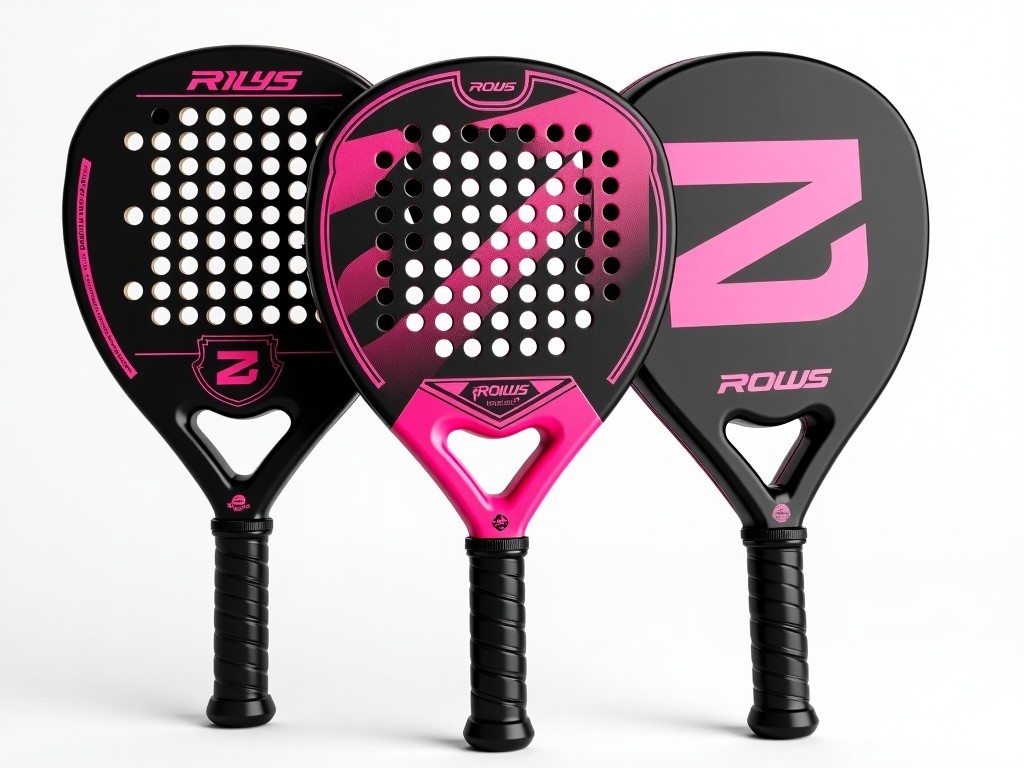
Custom Womens Padel Racket Manufacturer
Player biomechanics influence optimal swing weight and balance point; a lighter head‑heavy configuration improves maneuverability for quick net play while maintaining sufficient mass for baseline
Custom Women's Padel Racket Manufacturer
Design Considerations for Women's Padel Rackets
Player biomechanics influence optimal swing weight and balance point; a lighter head‑heavy configuration improves maneuverability for quick net play while maintaining sufficient mass for baseline power.
Grip circumference typically ranges from 100 mm to 106 mm to accommodate average female hand size, reducing fatigue during extended rallies and allowing precise wrist action.
Material Selection and Layup
High‑modulus carbon fiber (T700/T800) provides tensile strength above 5 GPa, enabling thin‑walled frames that resist deformation under impact loads exceeding 200 N.
Epoxy resin systems with a glass transition temperature around 130 °C cure under 120 °C pressure, yielding a void content below 0.5 % and consistent interlaminar shear strength.
Layup sequences combine 0° axial fibers for longitudinal stiffness, ±45° layers for torsional resistance, and 90° hoop fibers to control ovalization under off‑center strikes.
Customization Parameters
Adjustable variables include total mass (340 g‑380 g), balance point (300 mm‑360 mm from butt), swing weight (240‑280 kg·cm²), and flex rating (RA 55‑70) to match player style.
Grip size, surface texture (smooth, sand‑filled, or perforated), and paint finish (matte, gloss, or custom graphics) can be specified without altering structural integrity.
Tolerance control holds mass within ±2 g, balance within ±3 mm, and flex within ±2 RA, ensuring repeatable performance across production batches.
Performance Specifications
| Parameter | Typical Range | Unit |
|---|---|---|
| Weight | 340‑380 | g |
| Balance Point (from butt) | 300‑360 | mm |
| Swing Weight | 240‑280 | kg·cm² |
| Flex Rating (RA) | 55‑70 | RA |
| Length | 455‑460 | mm |
| Head Size | 260‑280 | cm² |
| Grip Circumference | 100‑106 | mm |
Values are typical; final specifications are confirmed during sample approval based on project requirements.
Manufacturing Process Overview
Prepreg sheets are cut to precise shapes using CNC lasers, ensuring fiber orientation tolerance within ±1° before placement in heated molds.
The layup undergoes vacuum bagging and autoclave curing at 120 °C and 3.5 bar for 90 minutes, achieving optimal resin flow and minimal void formation.
Post‑cure machining removes flash, drills string holes to ±0.1 mm accuracy, and applies edge protectors that increase impact resistance by approximately 15 %.
Quality Assurance and Testing
Incoming material checks verify fiber areal weight (±2 %), resin content (±1 %), and tensile strength via standardized coupon tests.
Finished rackets are measured for mass, balance point, and swing weight on calibrated machines; dimensions are inspected with CMM to ensure tolerances of ±0.2 mm.
Dynamic flex testing applies a sinusoidal load at 10 Hz, recording stiffness loss; acceptable frames show less than 2 % deviation after 10⁴ cycles.
Visual inspection checks for surface defects, paint adhesion, and grip alignment before packaging.
Applications and Use Cases
Club‑level competitors benefit from a balanced weight distribution that facilitates rapid transitions between defensive lobs and offensive volleys.
Training programs often select rackets with higher flex ratings to reduce arm strain during repetitive drills, while advanced players may opt for stiffer configurations to maximize power transfer.
Recreational players appreciate enlarged sweet spots achieved through optimized hoop fiber layout, improving consistency on off‑center hits.
Ordering and Lead Times
Minimum order quantity starts at 50 units; sample production typically requires 10‑12 business days after design approval.
Full production lead time ranges from 4 to 6 weeks, depending on lot size and complexity of custom finishes.
Products are packed in corrugated cartons with internal foam separators, each unit wrapped in anti‑static film to prevent surface abrasion during transit.
Shipping options include EXW, FOB, or DDP; documentation provides material safety data sheets and compliance certificates upon request.


