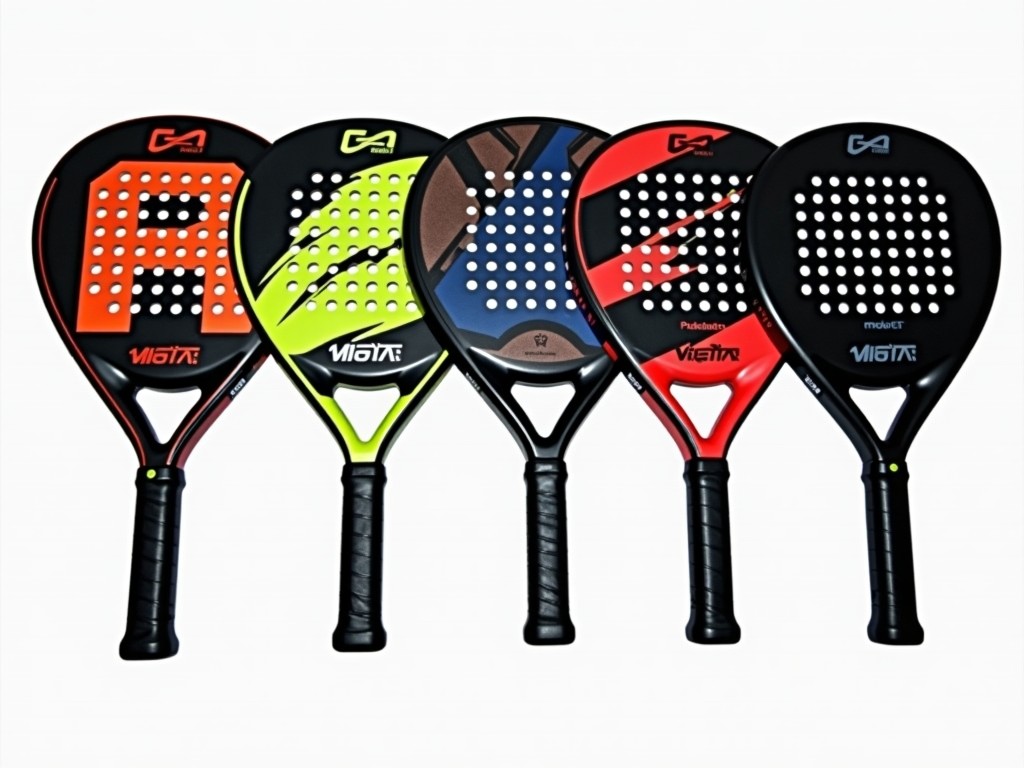
Direct Factory Personalized Teardrop Padel Rackets Top Supplier
The teardrop geometry shifts the sweet spot upward, offering a larger effective hitting area while maintaining maneuverability for quick volleys. This shape also influences weight distribution,
Direct Factory Personalized Teardrop Padel Rackets – Top Supplier
The teardrop geometry shifts the sweet spot upward, offering a larger effective hitting area while maintaining maneuverability for quick volleys. This shape also influences weight distribution, allowing players to fine‑tune balance between power and control through core density and frame thickness.
Design and Geometry
A typical teardrop padel racket features a wide throat that tapers to a narrow tip, creating a surface area of approximately 460 cm². The frame depth usually ranges from 22 mm to 24 mm, which affects stiffness and vibration damping.
Weight is distributed with a bias toward the head, resulting in a balance point around 260 mm from the butt cap for a 350 g racket. Adjusting the internal foam core thickness shifts this point by ±5 mm without altering overall mass.
Material Options
Core materials vary between EVA foam of differing densities and polyethylene‑based foams, each delivering distinct feel and rebound characteristics. The outer shell commonly uses layers of carbon fiber fabric combined with epoxy resin, where the number of plies and orientation dictate tensile strength and flex.
- Low‑density EVA (≈30 kg/m³) – softer feel, larger sweet spot
- Medium‑density EVA (≈45 kg/m³) – balanced power and control
- High‑density EVA (≈60 kg/m³) – firmer response, increased durability
- Carbon fiber layup – 3K, 6K, or 12K weave options affecting stiffness
Customization Capabilities
Personalization extends beyond cosmetic graphics to functional attributes that affect play. Grip size can be adjusted from 4 in to 4 ⅜ in by altering the overwrap thickness or using different base grips.
Weight tuning is achieved by inserting tungsten or brass plugs into the handle cavity, allowing adjustments of ±10 g in 2 g increments. Balance point customization is realized by varying core thickness or adding peripheral weight strips along the frame.
Surface finishes include matte, gloss, or textured coatings, each influencing friction with the ball and wear resistance. Custom logos are applied via sublimation printing that penetrates the coating layer, ensuring durability under repeated impact.
Manufacturing Process
Production begins with CNC‑milled aluminum molds that mirror the exact teardrop profile, including internal chambers for foam injection. Pre‑impregnated carbon fiber sheets are laid up by hand or automated tape‑laying machines to achieve the desired ply orientation.
The assembled blank is placed in a hydraulic press where heat (≈150 °C) and pressure (≈120 bar) cure the epoxy resin while simultaneously compressing the foam core to its final density. Cooling under controlled conditions prevents residual stresses that could lead to frame warping.
After demolding, rackets undergo trimming, drilling for string holes, and application of the chosen grip and cosmetic layers. Each unit receives a unique serial number for traceability.
Quality Control and Testing
Dimensional inspection verifies length (±2 mm), width (±1 mm), and thickness (±0.2 mm) using calibrated calipers and coordinate‑measuring machines. Weight is measured to within ±1 g on a precision balance.
Impact testing simulates ball strikes at speeds up to 120 km/h using a pneumatic actuator; the racket must exhibit no delamination or crack initiation after 5,000 cycles. Flexural modulus is assessed via three‑point bending, confirming that the frame stays within the design range of 4.5 – 5.5 GPa.
Surface adhesion of the printed graphics is evaluated with a cross‑hatch tape test per ASTM D3359, requiring a rating of 4B or higher to ensure coating integrity.
Typical Specifications
| Parameter | Range / Typical Value |
|---|---|
| Overall Length | 455 mm ± 2 mm |
| Head Width | 260 mm ± 1 mm |
| Frame Depth | 22 mm – 24 mm |
| Weight (unstrung) | 340 g – 380 g |
| Balance Point | 255 mm – 270 mm from butt cap |
| Core Material | EVA foam (30 – 60 kg/m³) |
| Carbon Fiber Layup | 3K / 6K / 12K, 8 – 12 plies |
| Grip Size Options | 4.0 in, 4.125 in, 4.25 in, 4.375 in |
Applications
The teardrop shape benefits players who rely on quick reaction at the net, as the upward‑biased sweet spot reduces the wrist flexion needed for defensive volleys. Intermediate to advanced players often select this geometry for its blend of power on smashes and control on placement shots.
Because the frame depth can be tuned without drastically altering weight, coaches use teardrop rackets to teach proper swing mechanics; the larger hitting area forgives slight timing errors while still providing feedback on technique.
Club distributors stock these rackets for leagues that emphasize fast‑paced rallies, where the combination of maneuverability and stable head weight supports consistent performance over extended play sessions.
Ordering Information and Lead Times
Minimum order quantity starts at 50 units for standard models; fully personalized runs (custom graphics, grip, weight) require a minimum of 30 units. Sample production typically takes 7‑10 business days after approval of digital artwork and specifications.
Lead time for mass production ranges from 18‑25 days depending on order complexity and current factory capacity. Shipping options include FOB Shanghai or CIF to major global ports, with packaging designed to protect against impact and moisture.
Frequently Asked Questions
- Can dimensions be customized beyond standard ranges? Yes, frame depth and head width can be adjusted within ±2 mm of the baseline, subject to mold feasibility.
- What information is required before quotation? Desired weight, balance point, core density, grip size, graphics files, and order quantity.
- Which materials are available for the core? Low, medium, and high density EVA foam, as well as optional polyethylene blends.
- How is quality inspected? Dimensional checks, weight verification, impact cycle testing, flexural modulus measurement, and adhesion testing.
- What packaging methods are available? Individual rackets in PE foam sleeves, placed in corrugated cartons with corner protectors; palletized for sea freight.
- How are export shipments protected? Cartons are sealed with moisture‑resistant tape and include silica gel packs; pallets are stretch‑wrapped and strapped.
- What is the typical production lead time? 18‑25 days for mass production; 7‑10 days for samples.
- How are samples arranged? Digital proof approval followed by prototype production; shipping costs are borne by the requester unless otherwise agreed.
To discuss your specific requirements or request a formal quotation, please reach out using the contact form below.
Send Inquiry


