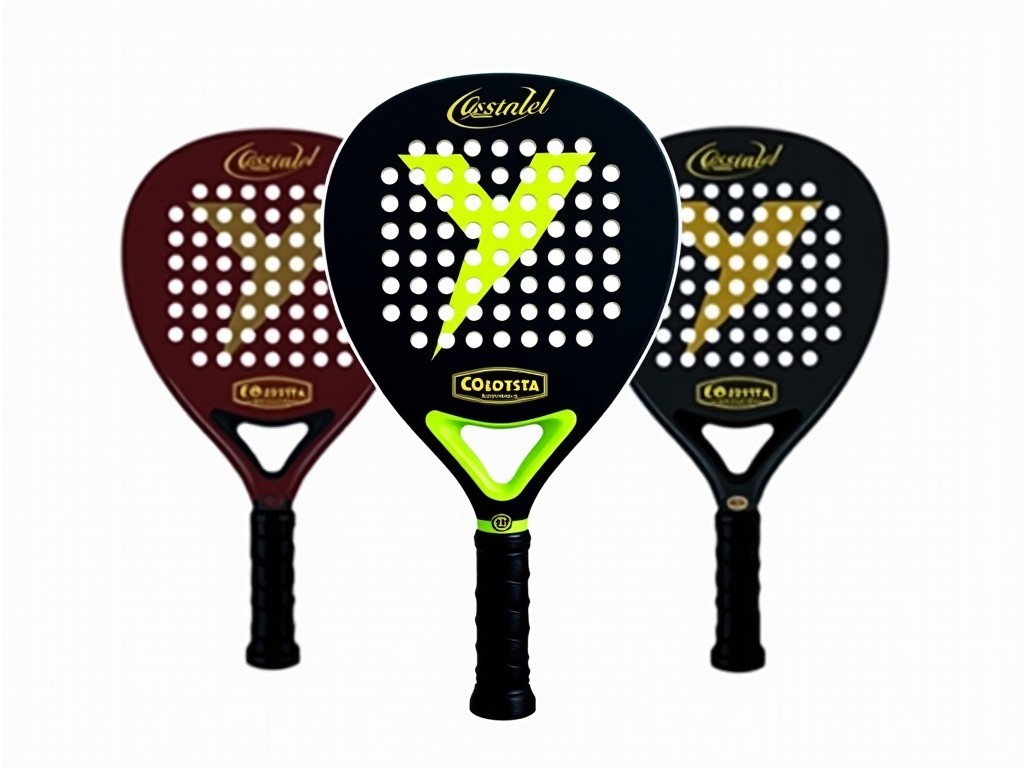
Wholesale Professional Padel Rackets Supplier
Padel rackets supplied for wholesale distribution are engineered to meet the performance demands of competitive play while maintaining consistency across large production batches. Understanding the
Wholesale Professional Padel Rackets – Technical Overview
Padel rackets supplied for wholesale distribution are engineered to meet the performance demands of competitive play while maintaining consistency across large production batches. Understanding the measurable design parameters helps procurement teams evaluate suitability for specific player levels and court conditions.
Frame Geometry and Mass Distribution
The frame length typically ranges from 455 mm to 460 mm, with a width of 260 mm at the throat and 240 mm at the tip. Mass is distributed to achieve a balance point between 260 mm and 280 mm measured from the butt cap, resulting in a head‑light feel that favors maneuverability. Swing weight, measured at 100 mm from the butt, falls between 260 kg·cm² and 280 kg·cm² for most professional models.
Wall thickness varies from 6 mm at the throat to 3 mm at the tip, providing a progressive stiffness gradient that enhances power transfer while reducing vibration transmission to the hand.
Core Materials and Construction
The core is commonly fabricated from ethylene‑vinyl acetate (EVA) foam with densities ranging from 30 kg/m³ to 45 kg/m³, selected to tune the coefficient of restitution between 0.45 and 0.55. Higher density cores increase rebound speed but also raise the overall mass.
The outer skin consists of layered carbon‑fiber reinforced polymer (CFRP) sheets, typically 3 mm to 4 mm thick, oriented at ±45° and 0° to optimize torsional stiffness and impact resistance. Some models incorporate a thin layer of basalt fiber to improve damping characteristics without adding significant weight.
Surface Texture and Spin Potential
The striking surface is treated with a silica‑based roughening agent that creates a microscopic roughness average (Ra) of 15 µm to 25 µm. This texture governs the friction coefficient between ball and racket, influencing spin generation; measured spin rates for a standard 30 m/s serve range from 120 rpm to 180 rpm depending on surface treatment.
Edge guards are manufactured from thermoplastic polyurethane (TPU) with a Shore A hardness of 85, providing abrasion resistance while adding less than 2 g to the total racket mass.
Typical Specification Table
| Parameter | Typical Range | Unit |
|---|---|---|
| Overall Length | 455 – 460 | mm |
| Mass (unstrung) | 340 – 380 | g |
| Balance Point | 260 – 280 | mm from butt |
| Swing Weight | 260 – 280 | kg·cm² |
| Core Density | 30 – 45 | kg/m³ |
| Surface Roughness (Ra) | 15 – 25 | µm |
Application Considerations for Different Player Segments
Recreational players benefit from rackets with a higher balance point (closer to 280 mm) and lower swing weight, which reduces forearm fatigue during extended sessions. Competitive athletes typically prefer a head‑light configuration (balance point near 260 mm) combined with a stiffer core to maximize shot velocity and control.
Climate also influences material choice; in humid environments, EVA cores with closed‑cell structures limit moisture absorption, preserving consistent performance over time. Manufacturers often provide optional anti‑UV coatings on the CFRP skin to mitigate degradation from prolonged sun exposure.
Customization Options for Wholesale Orders
- Adjustable weight kits (tungsten or steel inserts) allowing ±10 g fine‑tuning.
- Grip size variations ranging from 100 mm to 110 mm circumference.
- Personalized graphics via sublimation printing on the CFRP surface.
- Optional vibration dampening inserts placed in the throat region.
Each customization parameter is evaluated for its impact on the overall mass distribution and structural integrity; lead times adjust accordingly based on tooling requirements.
Quality Control and Testing Protocols
Incoming raw materials are inspected for tensile strength (CFRP ≥ 3500 MPa) and foam density (± 2 kg/m³ tolerance). Dimensional verification uses laser scanning to confirm frame geometry within ±0.5 mm. Finished rackets undergo impact testing with a standardized ball at 35 m/s; acceptable deformation is less than 0.8 mm peak displacement.
Batch sampling includes a frequency response analysis to ensure the first bending mode falls between 120 Hz and 150 Hz, indicating consistent stiffness across the lot. All test results are recorded and available for review upon request.
Packaging and Logistics
Rackets are packed in triple‑wall corrugated cartons with internal foam inserts that immobilize each unit, limiting movement to less than 2 mm during transit. Cartons are marked with handling symbols indicating “keep dry” and “this side up”. Standard pallet configuration holds 48 units, facilitating efficient container loading.
For international shipments, moisture‑barrier liners are included to protect against humidity fluctuations, and each pallet is secured with poly‑strapping rated for 500 kg tensile strength.
Frequently Asked Questions
- Can the weight and balance be customized? Yes, weight inserts and grip adjustments allow modifications within ±10 g and ±5 mm balance shift.
- What information is required for a quotation? Desired quantity, target weight range, preferred core density, and any graphic or grip specifications.
- Which materials are available for the core? EVA foam with densities from 30 kg/m³ to 45 kg/m³; alternative polyurethane foams are offered upon request.
- How is quality inspected before shipment? Dimensional scan, tensile sampling, impact deformation test, and modal analysis on a statistically significant sample.
- What packaging options exist for bulk orders? Standard carton with foam inserts, optional double‑boxing for extra protection, and eco‑friendly recycled cardboard variants.
- How are export shipments protected against damage? Moisture‑barrier liners, corner protectors, and strapped pallets conforming to ISPM‑15 standards.
- What is the typical production lead time? 3‑4 weeks for standard configurations; 5‑6 weeks when custom tooling or graphics are involved.
- Are samples available for evaluation? Yes, sample units can be arranged after receipt of a formal request and agreement on sample costs.
Next Steps
To receive a detailed quotation or discuss specific technical requirements, please reach out using the contact form below. Our engineering team will review your specifications and provide a response within one business day.
Contact Us for a Quote


