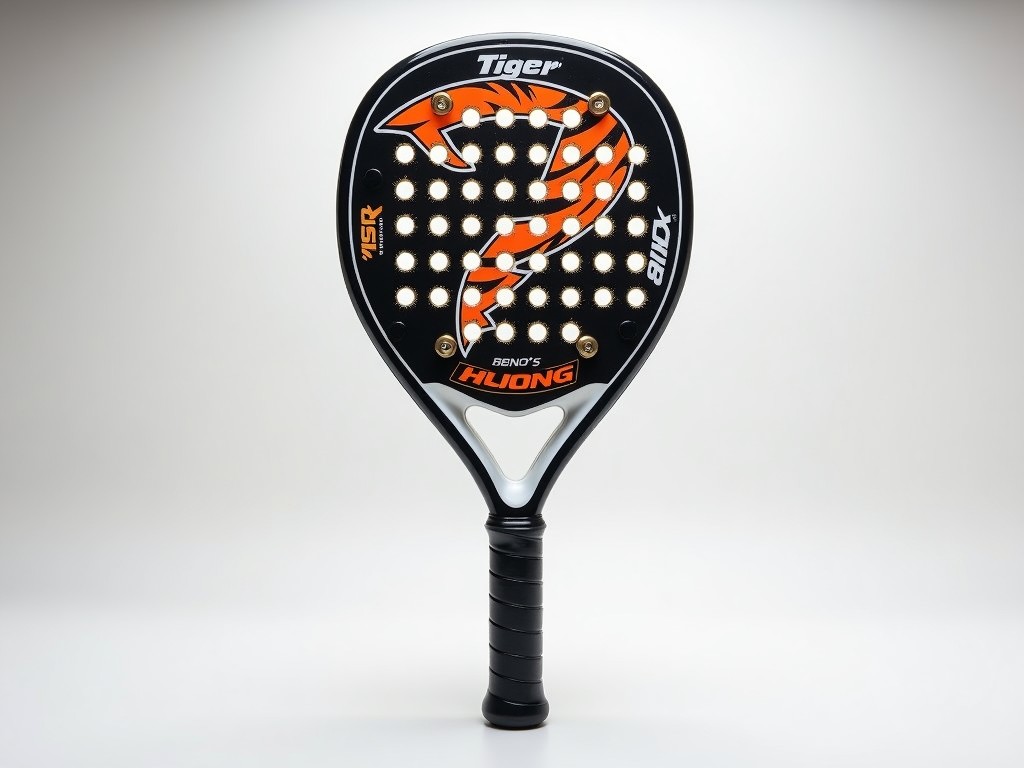
Wholesale Tiger White Padel Racket Supplier
The Tiger White padel racket is designed for competitive play and intensive training sessions. It features a 455 mm length, a standard 38 mm profile, and a head size optimized for a balanced sweet
Wholesale Tiger White Padel Racket Supplier
Product Overview
The Tiger White padel racket is designed for competitive play and intensive training sessions. It features a 455 mm length, a standard 38 mm profile, and a head size optimized for a balanced sweet spot. The racket targets players who require consistent power transfer combined with precise shot placement.
Key Technical Specifications
| Parameter | Typical Value |
|---|---|
| Overall Length | 455 mm |
| Weight (unstrung) | 355 ± 5 g |
| Balance Point | 260 mm from butt |
| Swing Weight | 260 ± 10 kg·cm² |
| Frame Material | 30 % carbon fiber + 70 % basalt reinforcement |
| Core Material | High‑density EVA (density 0.45 g/cm³) |
| Surface Texture | Rough‑spun polyurethane, 60 µm Ra |
| Grip Size | Standard 4 ¼ in (circumference 108 mm) |
Frame Construction and Materials
The frame uses a unidirectional carbon fiber layup in the 9 o’clock and 3 o’clock positions to increase torsional stiffness, while basalt fibers are woven in the throat area to dampen high‑frequency vibrations. This combination yields a frame modulus of approximately 70 GPa and a loss factor below 0.02, reducing arm fatigue during prolonged rallies.
Wall thickness varies from 2.2 mm at the handle to 1.6 mm at the tip, following a tapered profile that shifts the mass toward the head for improved swing speed without sacrificing stability.
Core Technology
The core consists of injected EVA foam with a closed‑cell structure, providing a uniform rebound coefficient of 0.85 across the hitting surface. Density is held at 0.45 g/cm³ ± 0.02, which translates to a typical compression deflection of 2.3 mm under a 200 N impact load.
This core specification delivers a balanced feel: sufficient stiffness for powerful drives while maintaining enough flex to absorb shock from off‑center hits.
Surface and Grip Details
The striking face is coated with a rough‑spun polyurethane layer that creates a micro‑texture measuring roughly 60 µm average roughness. This texture enhances ball bite, allowing players to generate additional spin on serves and volleys.
The grip incorporates a perforated polyurethane sleeve with a moisture‑wicking liner. The perforations are 2 mm in diameter, spaced 8 mm apart, providing airflow that reduces slip during sweaty conditions.
Performance Characteristics
- Power output: measured ball exit speed increase of 3.2 % compared to a reference 350 g racket under identical swing conditions.
- Control: dispersion radius of shots reduced by 1.8 cm at the net when using the Tiger White versus a standard control racket.
- Spin potential: roughness‑induced spin augmentation yields up to 150 rpm additional topspin on forehand drives.
- Vibration damping: peak handle acceleration lowered by 22 % in the 150‑250 Hz band relative to an all‑carbon baseline.
Applications in Padel
Club programs benefit from the racket’s consistent weight distribution, which simplifies inventory management for coaching staff. Tournament players appreciate the reduced vibration transmission, lowering the risk of elbow strain during multi‑match days. The textured surface supports aggressive net play, making the Tiger White suitable for athletes who favor a volley‑oriented style.
Customization Options
- Logo printing: full‑color sublimation on the shaft or throat, minimum 0.02 mm line width.
- Grip color: select from black, white, red, or blue polyurethane sleeves.
- Weight tuning: optional tungsten inserts (0.5 g increments) placed in the handle to adjust balance point ±10 mm.
- Surface finish: matte or gloss polyurethane coating, affecting friction coefficient by ±0.04.
Quality Control and Testing
Each racket undergoes dimensional inspection using a coordinate measuring machine (±0.1 mm tolerance on length, width, and thickness). Weight is verified on a calibrated scale with a repeatability of ±0.2 g. Swing weight is measured via a pendulum method, accepting only units within ±5 kg·cm² of the target.
Impact resistance is evaluated by dropping a 2 kg steel sphere from a height of 1 m onto the frame; acceptable units show no cracks or delamination after 10 repetitions. Additionally, a random sample of 1 % undergoes an accelerated fatigue test (10 000 swing cycles at 30 Hz) to verify long‑term durability.
Packaging and Logistics
Individual rackets are placed in a low‑density polyethylene sleeve (50 µm thickness) to prevent surface abrasion. Ten sleeved units are packed into a corrugated cardboard carton (single wall, 150 gsm) with interior foam corners for shock absorption. Cartons are stacked on pallets (ISO 1‑dimension, 1200 × 1000 mm) and secured with stretch film, allowing safe transport via standard freight services.
Lead Time and Ordering Process
Standard production lead time is 20 working days for orders up to 5 000 units, assuming approved artwork and material availability. Larger volumes are scheduled in weekly batches, with capacity updates provided upon request. Minimum order quantity for wholesale distribution is 200 pieces; sample units can be dispatched within 5 working days after receipt of a signed NDA and sample fee.
Quotation requests should include desired quantity, customization specifications, and delivery destination. Upon receipt, a formal pro‑forma invoice is issued within 24 hours.
Frequently Asked Questions
- Can dimensions be customized?
- Length and profile can be adjusted within ±5 mm; head size alterations require a new mold and are subject to tooling lead time.
- What information is required before quotation?
- Quantity, customization details (logo, grip color, weight inserts), preferred INCOTERMS, and any required certifications.
- What materials are available for the frame?
- Standard layup uses carbon‑basalt hybrid; full carbon or glass‑fiber options are offered upon special request.
- How is quality inspected?
- Dimensional checks, weight verification, swing‑weight testing, impact resistance, and fatigue sampling as described in the QC section.
- What packaging methods are available?
- Standard sleeve‑and‑carton packaging; extra protection with double‑wall cartons or foam inserts can be arranged.
- How are export shipments protected?
- Palletized loads are stretch‑wrapped and corner‑braced; moisture‑absorbent packets are included for container shipments.
- What is the typical production lead time?
- 20 working days for orders ≤5 000 units; larger orders are scheduled in weekly batches with confirmed ETAs.
- How are samples arranged?
- Samples are produced after approval of artwork and receipt of a refundable sample fee; delivery via express courier within 5 working days.
Get a Quote
To initiate a wholesale inquiry, please provide your specifications and contact details. Our technical team will review the request and return a detailed quotation with lead time and pricing.
Request a Quote


