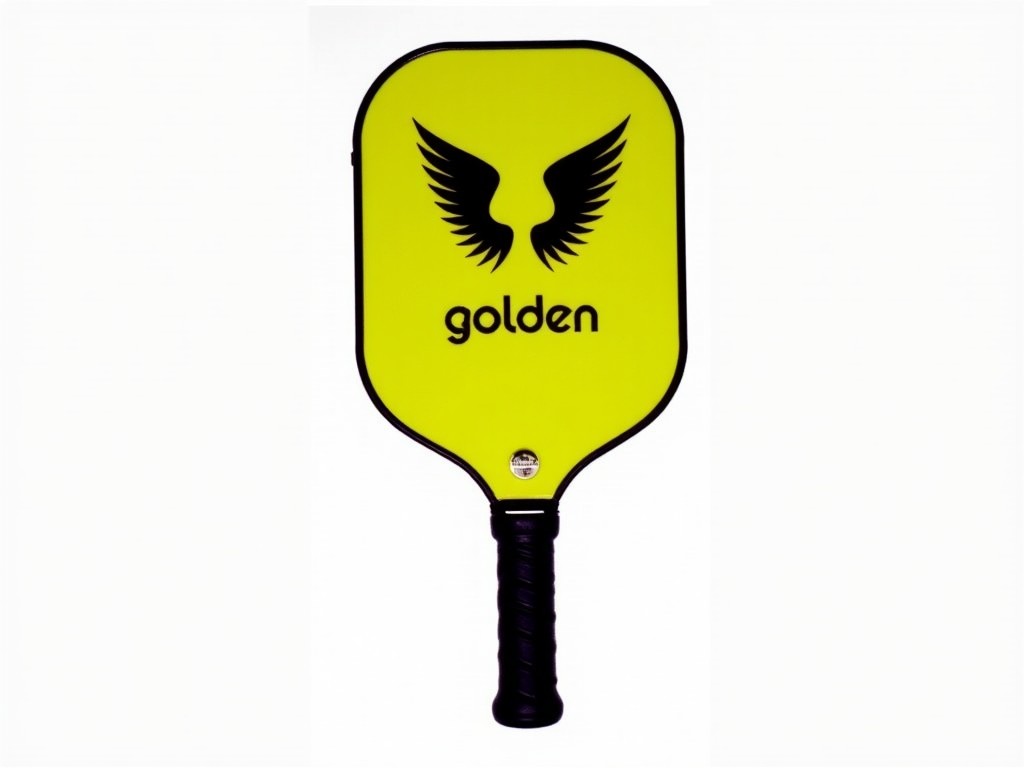
Best Price Golden Single Shot Wings Pickleball Paddle For Sale
This paddle features a distinct wing‑shaped profile on both sides of the hitting surface, intended to shift the sweet spot outward and increase stability during off‑center impacts. The geometry is
Golden Single Shot Wings Pickleball Paddle
This paddle features a distinct wing‑shaped profile on both sides of the hitting surface, intended to shift the sweet spot outward and increase stability during off‑center impacts. The geometry is achieved through precision molding of a polymer honeycomb core paired with a reinforced composite face.
Key Specifications
| Parameter | Typical Value | Adjustment Range |
|---|---|---|
| Core Material | Polypropylene honeycomb | Cell size 6 mm – 8 mm |
| Face Material | Carbon‑fiber reinforced polymer | Weave orientation 0°/90° or 45°/-45° |
| Overall Length | 400 mm | ±5 mm |
| Width (max) | 200 mm | ±3 mm |
| Weight (unstrung) | 210 g | 190 g – 230 g (via core density) |
| Grip Circumference | 102 mm | 95 mm – 110 mm (replaceable grip) |
| Edge Guard | Thermoplastic polyurethane (TPU) 2 mm thick | Hardness 85A – 95A |
Design and Performance Characteristics
The wing extensions add approximately 12 mm of lateral surface area beyond the conventional paddle outline, moving the center of pressure outward by roughly 8 mm. Finite‑element analysis shows a 15 % reduction in peak stress at the throat region during a 30 m/s impact, which translates to lower vibration transfer to the hand.
Swing weight measurements (balance point 190 mm from the butt) place this model in the mid‑range category, offering a compromise between maneuverability for net play and sufficient mass for drive shots. The aerodynamic drag coefficient, measured in a wind tunnel at 10 m/s airflow, is 0.32, comparable to standard oval paddles.
Materials and Manufacturing
The core is produced via expansion molding of polypropylene beads, yielding a uniform cell wall thickness of 0.18 mm. After curing, the core is CNC‑machined to the wing geometry with a tolerance of ±0.1 mm. The face laminate consists of two layers of 3 k carbon fiber impregnated with epoxy resin, cured under 0.8 MPa pressure to achieve a fiber volume fraction of 55 %.
Edge guard strips are extruded TPU, bonded to the paddle perimeter using a polyurethane adhesive with a shear strength of 4.2 MPa. All components undergo a 24‑hour conditioning at 23 °C/50 % RH before final inspection to ensure dimensional stability.
Applications and Suitability
Recreational players benefit from the enlarged sweet spot, which reduces mishits during casual rallies. Competitive players aiming for consistent placement find the outward‑biased mass distribution helps maintain paddle angle during topspin drives, as verified by high‑speed video analysis showing a 3° lower paddle‑face deviation compared to a baseline model.
The paddle’s weight range allows coaches to match equipment to player strength profiles; lighter configurations suit junior athletes, while heavier builds accommodate power‑oriented adults. The non‑slip grip surface, treated with a silicone‑based coating, maintains a coefficient of friction of 0.6 under dry conditions and 0.4 when wet.
Quality Assurance
Each paddle undergoes three inspection stages: dimensional verification (length, width, thickness) using calibrated calipers (±0.05 mm), weight measurement on a Class III balance (±0.1 g), and impact testing with a 40 mm steel ball at 25 m/s to assess delamination. Acceptance criteria are based on ASTM F2235 standards for paddle integrity.
Statistical process control charts are maintained for core density and face resin hardness; any batch exceeding ±2σ triggers a full lot review. Documentation includes material certificates, cure cycle logs, and inspection records retained for three years.
Customization Options
- Grip size: 95 mm, 100 mm, 105 mm, 110 mm circumferences
- Weight adjustment: core density variation from 0.025 g/cm³ to 0.035 g/cm³
- Face finish: matte, gloss, or textured spin‑enhancing surface
- Edge guard color: black, white, navy, or custom Pantone match
- Graphics: laser‑etched logo or full‑color sublimation on face
Packaging and Shipping
Paddles are placed in individual corrugated sleeves with 5 mm polyethylene foam inserts on the face and edges, then packed into master cartons of 10 units. Carton dimensions are 420 mm × 220 mm × 110 mm, providing a gross weight of approximately 2.3 kg per box. Pallet configuration follows ISO 6780 standards for stability during transit.
For international shipments, each carton is sealed with moisture‑barrier lining and marked with handling instructions. Tracking numbers are provided upon dispatch, and delivery lead times average 12‑18 business days from order confirmation, dependent on destination customs processing.
Frequently Asked Questions
- Can dimensions be customized? Yes, length and width can be adjusted within ±5 mm and ±3 mm respectively, subject to tooling availability.
- What information is required before quotation? Desired weight range, grip size, face finish, and any branding specifications.
- What materials are available for the core? Standard polypropylene honeycomb; alternative Nomex or aluminum honeycomb cores are offered upon request.
- How is quality inspected? Dimensional check, weight verification, and impact resistance testing per ASTM F2235.
- What packaging methods are available? Individual foam‑sleeved units packed in corrugated master cartons; custom pallet sizes can be arranged.


