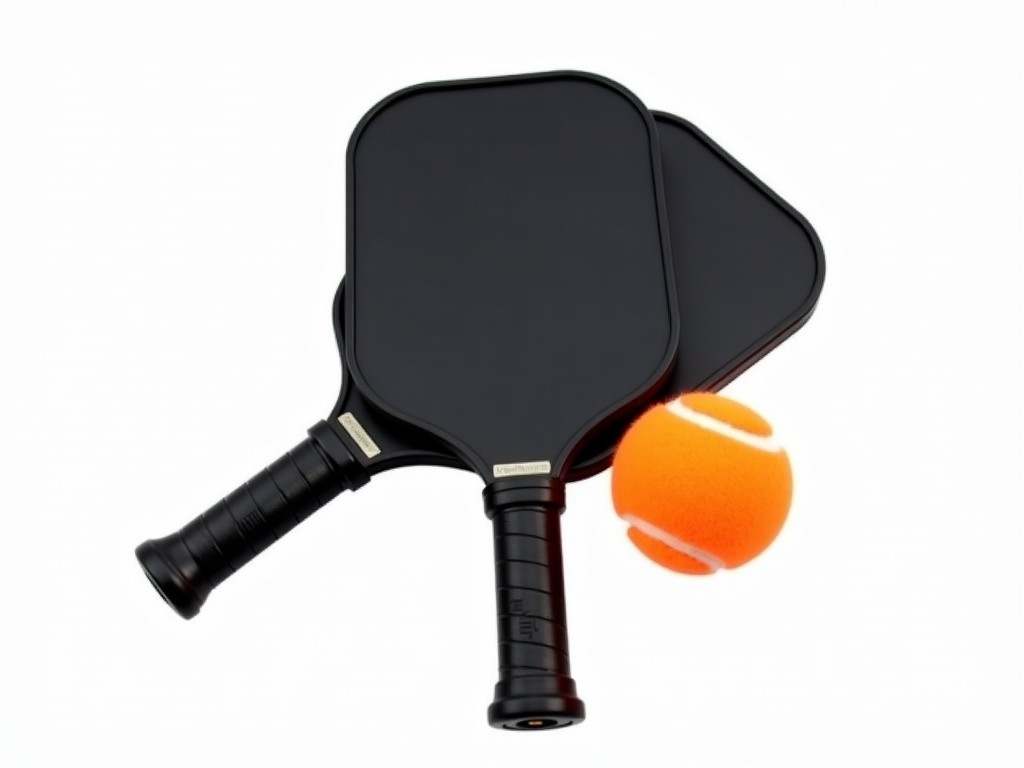
China Graphite Pickleball Paddle Supplier
This page explains the technical attributes of graphite‑based pickleball paddles produced for industrial buyers. Information focuses on measurable properties, manufacturing considerations, and how
Graphite Pickleball Paddle – Supplier from China
This page explains the technical attributes of graphite‑based pickleball paddles produced for industrial buyers. Information focuses on measurable properties, manufacturing considerations, and how the product meets performance requirements in recreational and competitive play.
Material and Construction
The paddle core consists of a layered graphite composite with a typical fiber volume fraction of 55 % to 60 %. The resin system is an epoxy‑amine blend cured at 150 °C for 90 minutes, yielding a flexural modulus around 12 GPa. Surface layers are over‑woven with a 3K graphite fabric to achieve a uniform thickness of 12.5 mm ±0.3 mm across the hitting zone.
Edge protection is applied via a 0.8 mm thick polyurethane rim, bonded with a structural adhesive that maintains shear strength above 4 MPa after 500 h of UV exposure. The grip area incorporates a perforated silicone overlay with a hardness of 45 ShA, providing a controlled friction coefficient of 0.35 under dry conditions.
Performance Characteristics
Key performance indicators are measured according to USAPA‑approved test methods. The following table summarizes typical values for a standard model; actual figures can be adjusted within the ranges shown to match specific play styles or regulatory limits.
| Parameter | Typical Value | Adjustable Range |
|---|---|---|
| Weight (unstrung) | 210 g | 190 g – 230 g |
| Balance Point (from handle end) | 190 mm | 175 mm – 205 mm |
| Surface Roughness (Ra) | 3.2 µm | 2.5 µm – 4.0 µm |
| Impact Strength (Charpy, notched) | 4.8 kJ/m² | 4.0 kJ/m² – 5.5 kJ/m² |
| Thermal Expansion Coefficient | 25 × 10⁻⁶ /K | 22 – 28 × 10⁻⁶ /K |
These values are derived from batch testing of production lots; individual paddles are supplied with a inspection sheet indicating actual measured parameters.
Customization Options
- Core thickness adjustable from 10 mm to 16 mm in 0.5 mm increments.
- Graphite fiber orientation can be set to 0°/90° quasi‑isotropic or ±45° bias for altered flex response.
- Surface finish options include matte, satin, or low‑gloss UV‑cured coating with specified gloss units (20 GU to 70 GU).
- Grip circumference can be tailored between 100 mm and 115 mm, with optional over‑wrap thickness of 0.5 mm to 2.0 mm.
- Weight tuning via internal tungsten or steel inserts, allowing final mass adjustment up to ±15 g.
Each customization request triggers a feasibility review that evaluates impact on balance point, swing weight, and durability before tooling is released.
Quality Control and Testing
Inspection begins with raw material verification: fiber areal weight measured via ASTM D3759, resin content checked by acid digestion, and gel time recorded to ensure proper cure. Dimensional inspection uses coordinate measuring machines with a tolerance of ±0.1 mm for thickness and ±0.5 mm for overall length.
Mechanical validation includes three‑point bend testing to confirm flexural modulus, impact testing per ASTM D256, and surface roughness profiling with a laser scanner. Every batch undergoes a minimum of 30 paddle samples for statistical process control; acceptable ranges are defined by control charts with Cp ≥ 1.33.
Final visual inspection checks for delamination, voids, or coating defects using 10× magnification; any defect exceeding 0.2 mm in depth results in rejection. Packaging verification ensures each unit is sealed in a moisture‑barrier bag with a desiccant pack rated for 5 g H₂O absorption.
Applications in Play Environments
The paddle’s high stiffness-to-weight ratio enables rapid acceleration during volleys, reducing swing time by approximately 8 % compared with a baseline aluminum core of equal mass. This attribute benefits players who rely on quick reflex exchanges at the net.
Uniform surface roughness ensures consistent ball spin generation; measured spin rates remain within ±5 % of target values across a range of impact speeds from 15 m/s to 25 m/s. Such predictability supports training regimens where repeatable ball response is required.
Environmental stability is achieved through low moisture absorption (<0.2 % after 24 h immersion) and UV‑stable coating, allowing outdoor use in temperatures ranging from –10 °C to 45 °C without measurable change in flexural properties.
Frequently Asked Questions
Yes. Non‑standard thicknesses, lengths, or grip shapes are evaluated case‑by‑case; tooling lead time typically adds 2–3 weeks.
Desired weight range, target balance point, surface finish preference, and any regulatory standards (e.g., USAPA, ITF) that apply.
Standard graphite‑epoxy composite; alternative cores such as carbon‑nanotube reinforced epoxy or honeycomb polypropylene are offered upon request.
Dimensional CMM checks, flexural modulus testing, impact resistance, and surface roughness scanning are performed on a statistically significant sample size per lot.
Each paddle is placed in a PE foam sleeve, sealed in a moisture‑barrier bag with desiccant, then packed in a double‑wall corrugated carton with corner protectors.
For standard configurations, lead time is 18–22 working days after receipt of approved artwork and deposit.
Get in Touch
If you need a detailed technical datasheet, sample arrangement, or wish to discuss a custom specification, please use the contact form below.
Submit Inquiry


