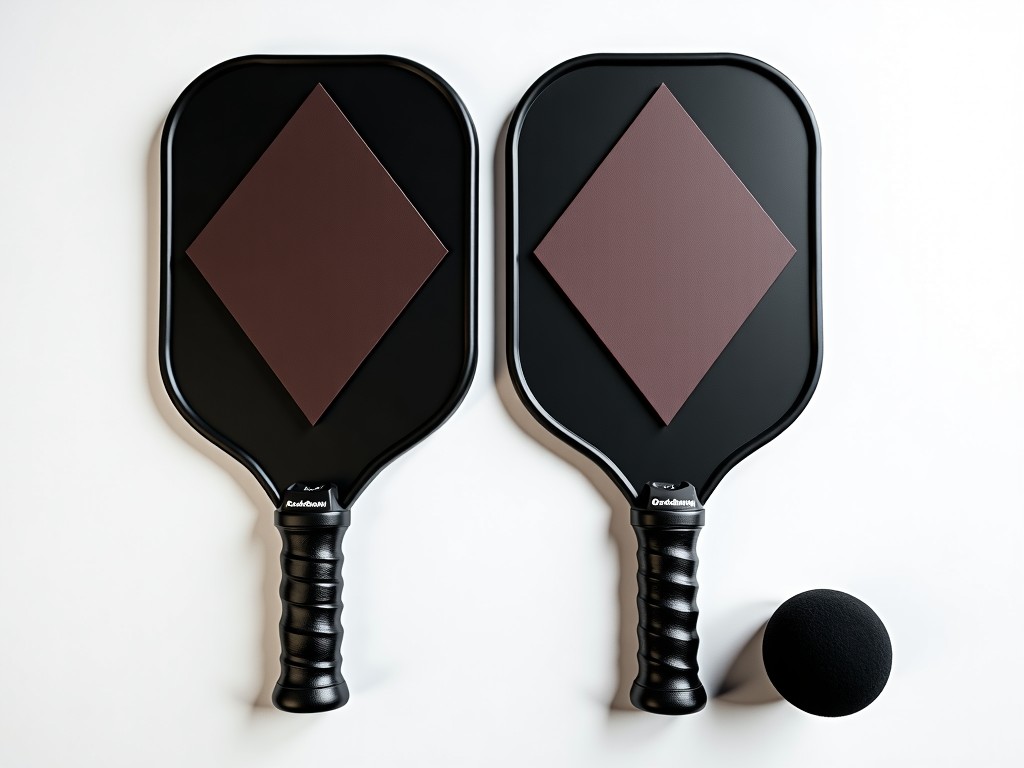
Custom Black Diamond Pickleball Paddle Manufacturer
The term black diamond describes a core architecture where diamond‑shaped cells are tiled in a repeating lattice. This geometry creates a directional stiffness distribution that varies with load
Custom Black Diamond Pickleball Paddle Manufacturer
The term black diamond describes a core architecture where diamond‑shaped cells are tiled in a repeating lattice. This geometry creates a directional stiffness distribution that varies with load angle, influencing both power transfer and vibration damping.
Core Material and Density
The core is typically a polypropylene honeycomb with a nominal density ranging from 0.025 to 0.035 g/cm³. Cell wall thickness is held between 0.15 and 0.25 mm, which defines the compressive modulus in the 150–250 MPa range for standard paddle thicknesses of 12–16 mm.
Face Layer Options
Surface layers are supplied as either graphite sheets (modulus ~230 GPa, thickness 0.3–0.5 mm) or carbon‑fiber reinforced polymer (modulus ~180 GPa, thickness 0.4–0.6 mm). The choice of face material affects the paddle’s flexural rigidity and the coefficient of restitution measured during ball impact.
Available Customization Parameters
- Target weight: 190–230 g (±2 g tolerance)
- Grip circumference: 100–115 mm (±0.5 mm)
- Edge guard material: TPU or rubber, thickness 1.0–2.0 mm
- Surface texture: matte, satin, or micro‑rough finish (Ra 0.8–2.5 µm)
- Color pigments: custom Pantone matches for face and core layers
Production Sequence
Production begins with core sheet lay‑up in a temperature‑controlled press (150 °C, 200 psi) for 90 seconds to activate the thermoplastic binder. After cooling, the CNC‑machined face sheet is bonded using a two‑part epoxy with a shear strength exceeding 12 MPa. Final trimming to the specified outline is performed on a 5‑axis router with a positional accuracy of ±0.1 mm.
Inspection and Tolerance Table
| Parameter | Typical Tolerance | Verification Method |
|---|---|---|
| Weight | ±2 g | Analytical balance (0.01 g readability) |
| Paddle length | ±0.5 mm | CMM measurement |
| Face thickness | ±0.05 mm | Micrometer (0.001 mm) |
| Flexural stiffness | ±5 % of target | Three‑point bend test (ASTM D790) |
Typical Industrial Applications
OEMs select this paddle design when consistent dynamic response across production batches is required for branding or promotional equipment. The defined weight tolerance and stiffness range allow integration into automated assembly lines where paddle mass influences conveyor timing and impact testing fixtures.
Frequently Asked Questions
Can dimensions be customized? Yes, length, width, and thickness are adjustable within the 380–410 mm length, 190–205 mm width, and 12–16 mm thickness ranges, subject to tooling constraints.
What information is required before quotation? Target weight, preferred face material, grip size, edge guard type, and any surface finish specifications are needed to generate a accurate cost estimate.
How is quality inspected? Each lot undergoes weight verification, dimensional checks, and flexural stiffness testing per the table above; results are recorded and supplied with the shipment.
What packaging methods are available? Paddles are packed in single‑wall corrugated cartons with internal PE foam inserts; custom pallet configurations can be arranged for bulk orders.
What is the typical production lead time? Lead time ranges from 15 to 25 business days after final design approval, depending on order volume and tooling availability.
Contact for Inquiry
To request a detailed quote or discuss specific engineering requirements, please use the inquiry form linked below.
Request Quote


