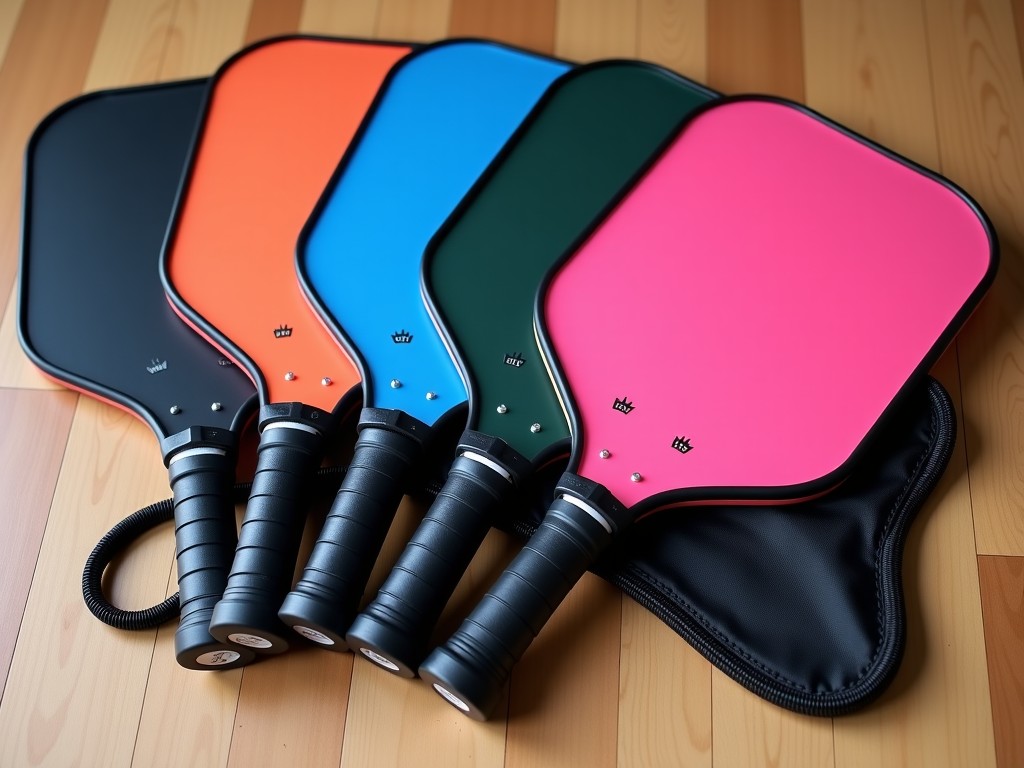
Custom Focus Training Pickleball Paddle Company
This section explains how a pickleball paddle designed for focused training differs from recreational models, emphasizing geometry, weight distribution, and surface texture that support repeatable
Custom Focus Training Pickleball Paddle Company
This section explains how a pickleball paddle designed for focused training differs from recreational models, emphasizing geometry, weight distribution, and surface texture that support repeatable stroke mechanics.
Materials and Construction
The paddle core is typically a polymer honeycomb or foam composite selected for consistent flexural rigidity across the hitting face. Face materials range from carbon‑fiber reinforced graphite to fiberglass blends, each offering a specific modulus that influences rebound velocity and vibration damping.
Edge guards are formed from extruded TPU or rubberized nylon, bonded with a low‑outgassing adhesive to prevent delamination under repeated impact. Grip overlays use perforated silicone or polyurethane with a controlled durometer to maintain tactile feedback while absorbing sweat.
Performance Characteristics
- Weight tolerance is held to ±2 g, allowing precise swing‑weight tuning for individual athlete biomechanics.
- Balance point can be shifted from head‑heavy (≈220 mm from butt) to handle‑heavy (≈180 mm) by adjusting core thickness distribution.
- Surface roughness is measured with a profilometer; typical Ra values range from 2 µm (smooth) to 8 µm (textured) to modulate spin generation.
- Vibration damping is quantified via modal analysis; target loss factor exceeds 0.03 to reduce elbow‑joint loading during repetitive drills.
Customization Options
| Parameter | Standard Range | Customizable per Project |
|---|---|---|
| Overall Length | 390 mm – 410 mm | ±10 mm increments |
| Face Width | 190 mm – 210 mm | ±5 mm increments |
| Core Thickness | 12 mm – 18 mm | 2 mm steps |
| Grip Circumference | 100 mm – 115 mm | 0.5 mm steps |
| Surface Finish | Matte, Satin, Gloss | Custom laser‑etched patterns |
Manufacturing Process
Core sheets are CNC‑cut to nominal thickness, then laminated under vacuum pressure to eliminate voids. Face plies are aligned using optical registration systems to ensure fiber orientation tolerance within ±2°. After lay‑up, the assembly undergoes a post‑cure cycle at 80 °C for 90 minutes to achieve final resin cross‑link density.
Edge guards are injection‑molded separately and ultrasonically welded to the paddle rim, providing a bond strength exceeding 2.5 MPa. Grips are applied via a wrap‑tension machine that maintains consistent overlap tension, preventing slippage during high‑frequency swing cycles.
Quality Control
Each paddle receives a three‑point flexural test to verify stiffness matches the design curve within ±5 %. Impact durability is evaluated using a standardized ball‑drop rig delivering 150 J energy; acceptable performance shows no delamination or core cracking after 500 repetitions.
Surface texture is inspected with a handheld profilometer; mean Ra must fall within the agreed tolerance band. Weight and balance are measured on a calibrated scale and balance beam, with results logged to a traceable serial number.
Applications
Training facilities use these paddles to isolate specific stroke mechanics; the controllable weight distribution lets coaches prescribe drills that target wrist snap versus shoulder rotation without altering grip size.
Rehabilitation centers select paddles with reduced vibration damping to provide proprioceptive feedback while minimizing joint stress during low‑impact rally practice.
OEMs supplying collegiate teams benefit from the ability to batch‑produce paddles with identical balance points, ensuring consistency across squad equipment inventories.
Comparison: Standard vs. Custom Focus Training Paddle
| Attribute | Standard Recreational Paddle | Custom Focus Training Paddle |
|---|---|---|
| Weight Tolerance | ±5 g | ±2 g |
| Balance Adjustability | Fixed | ±20 mm range |
| Surface Roughness (Ra) | 3 µm – 6 µm (uncontrolled) | 2 µm – 8 µm (specified) |
| Vibration Loss Factor | ≈0.015 | ≥0.030 |
| Lead Time (units) | 2–3 weeks (stock) | 4–6 weeks (custom) |
Frequently Asked Questions
- Can dimensions be customized? Yes, length, width, thickness, and grip circumference can be adjusted in the increments shown in the customization table.
- What information is required before quotation? Desired weight range, target balance point, preferred face material, surface texture specification, and order quantity.
- What materials are available for the core? Polymer honeycomb, foam composite, or hybrid configurations; exact selection depends on stiffness and damping requirements.
- How is quality inspected? Each unit undergoes flexural, impact, surface profilometry, weight, and balance checks as outlined in the quality control section.
- What packaging methods are available? Individual paddles are placed in low‑static polyethylene sleeves, then packed in corrugated cartons with corner protection; palletization is optional for bulk shipments.
- How are export shipments protected? Cartons are sealed with moisture‑resistant tape and marked with handling labels; optional desiccant packs are available upon request.
- What is the typical production lead time? Custom orders typically require 4–6 weeks after final drawing approval; stock items ship within 2–3 weeks.
- How are samples arranged? Sample paddles can be produced after receipt of a technical specification sheet; shipping costs are billed to the requester.
Get a Quote
To begin a custom focus‑training paddle project, provide your performance targets and material preferences via our inquiry form.
Request Technical Quote


