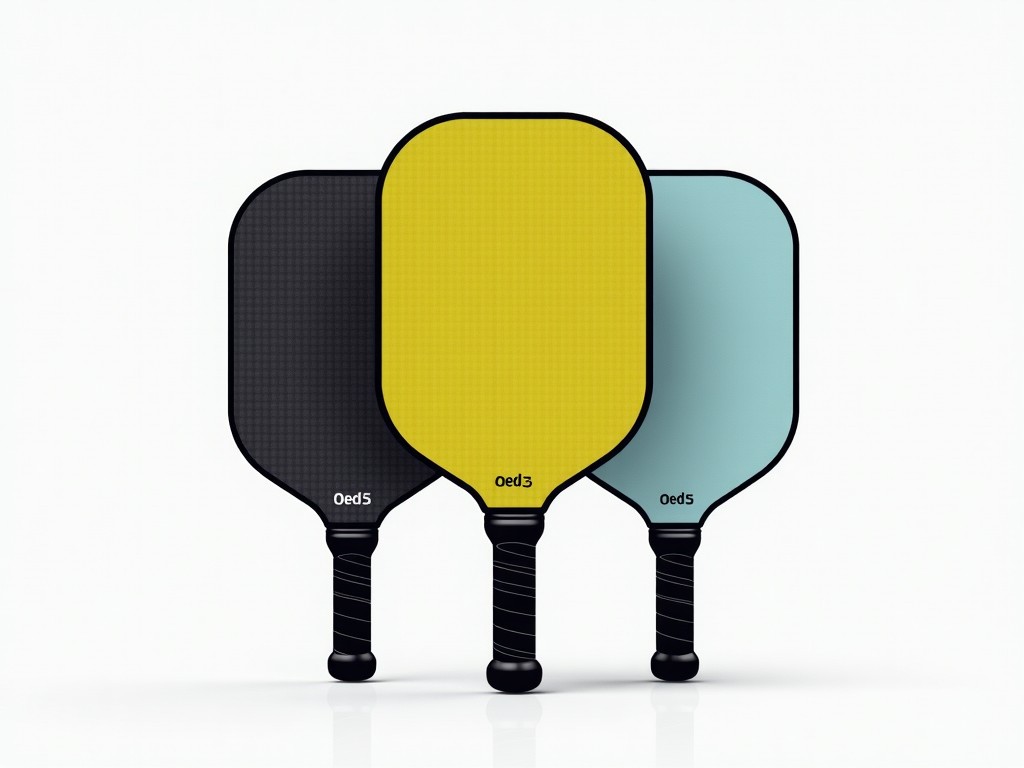
Factory Direct Carbon Fiber Pickleball Paddle Supplier
Carbon fiber pickleball paddles combine high tensile strength with low density, delivering a stiffness‑to‑weight ratio that improves swing speed while maintaining control. As a factory‑direct
Factory Direct Carbon Fiber Pickleball Paddle Supplier
Overview
Carbon fiber pickleball paddles combine high tensile strength with low density, delivering a stiffness‑to‑weight ratio that improves swing speed while maintaining control. As a factory‑direct supplier we control the layup, resin system, and curing cycle to achieve consistent performance across production lots.
Material Composition and Layup
The paddle face uses a unidirectional T700 carbon fiber prepreg oriented at 0° and 90° to maximize in‑plane modulus. A thin layer of woven 3K carbon fiber provides surface toughness and impact resistance. The core is a polypropylene honeycomb with cell size 6 mm and density 32 kg/m³, selected for its damping characteristics and moisture stability.
- Face: T700 UD prepreg (45 % weight) + 3K woven (15 % weight)
- Core: PP honeycomb, 12 mm thickness
- Edge guard: PU injection‑molded rim, Shore A 85
Mechanical Properties
| Property | Typical Value | Test Method |
|---|---|---|
| Flexural Modulus (face) | 70 GPa | ASTM D790 |
| Paddle Weight (unstrung) | 210 ± 5 g | ISO 7211‑1 |
| Impact Resistance (edge) | No cracking at 2 J impact | ASTM D5420 |
| Moisture Absorption (24 h, 23 °C) | <0.2 % weight gain | ASTM D570 |
Dimensional Tolerances
Overall length is held to ±1.0 mm, width ±0.8 mm, and thickness ±0.2 mm. These limits are monitored with laser micrometers on each paddle after final trim, ensuring compatibility with USAPA specification sheets and reducing the need for post‑machining by OEMs.
Customization Options
Customers can specify face orientation, core thickness, edge guard profile, and surface finish. Adjustments to layup angle shift the sweet spot location, while core height variations modify the paddle’s rebound coefficient. All changes are quoted based on tooling impact and material usage.
- Face angle: 0°/90°, 45°/‑45°, or hybrid
- Core thickness: 8 mm, 10 mm, 12 mm, 14 mm
- Edge guard: rounded, beveled, or flared
- Surface finish: matte UV‑cured, glossy polyurethane, or textured grip layer
Quality Control Process
Each batch undergoes incoming fiber areal weight verification, resin content measurement by FTIR, and cure monitoring via dielectric analysis. After molding, paddles are inspected for void content (<2 % via ultrasonic scan), dimensional compliance, and surface roughness (Ra < 0.8 µm). Final functional testing includes a pendulum swing test to verify impact force consistency within ±5 % across a lot.
Applications in Sports Equipment Manufacturing
Pickleball paddle manufacturers require a product that delivers consistent ball response, minimal vibration transfer to the hand, and durability under repeated impact. The carbon‑fiber/ honeycomb construction provides a high specific stiffness that reduces paddle flex during fast volleys, while the honeycomb core absorbs energy, lowering the risk of elbow strain. These attributes make the paddle suitable for competitive play, recreational clubs, and OEM private‑label lines where performance repeatability is a purchasing criterion.
FAQ
Can dimensions be customized? Yes, length, width, thickness, and edge profile can be adjusted within standard tooling limits.
What information is required before quotation? Provide desired face orientation, core thickness, edge guard style, surface finish, and annual volume.
What materials are available? T700 UD prepreg, 3K woven carbon fiber, polypropylene honeycomb, and optional aramid or glass hybrid cores.
How is quality inspected? Incoming material checks, in‑process cure monitoring, ultrasonic void scan, dimensional laser measurement, and final pendulum impact test.
What packaging methods are available? Individual paddle sleeves, corrugated cartons with foam inserts, or palletized bulk packs for container shipment.
How are export shipments protected? Cartons are lined with moisture‑barrier film and corner boards; pallets are stretch‑wrapped and strapped according to ISPM‑15.
What is the typical production lead time? 4‑6 weeks for standard configurations; 8‑10 weeks for new tooling or special layups.
How are samples arranged? Sample paddles are produced after design approval and shipped via express courier; sample fees are credited against first production order.
Contact for Quote
Ready to discuss your specifications? Submit a request for quotation and our engineering team will reply with a detailed technical proposal within one business day.


