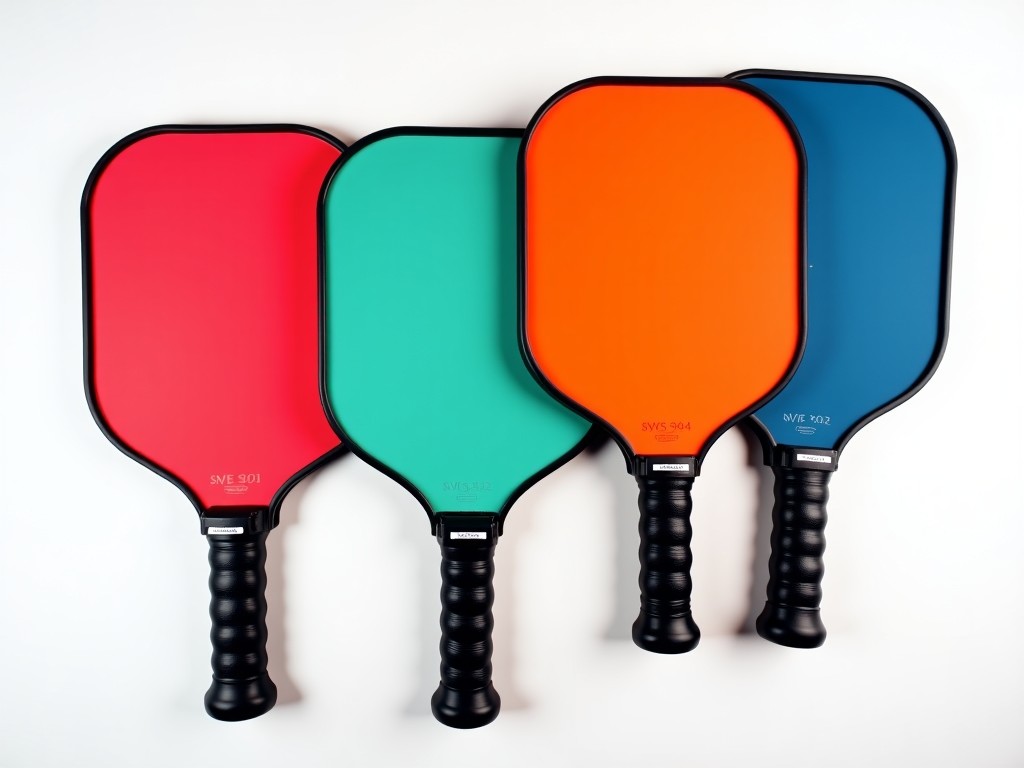
Wholesale Pickleball Paddles With Long Handles Factory
A longer handle shifts the paddle’s balance toward the butt cap, increasing leverage for two‑handed strokes and reducing wrist strain during extended play sessions. Typical cores consist of polymer
Wholesale Pickleball Paddles with Long Handles – Factory Direct
A longer handle shifts the paddle’s balance toward the butt cap, increasing leverage for two‑handed strokes and reducing wrist strain during extended play sessions.
Typical cores consist of polymer honeycomb (polypropylene) with cell sizes 6‑8 mm, providing a density range of 0.9‑1.2 g/cm³ and a compressive strength around 0.4 MPa; alternative cores use Nomex aramid paper (density 0.3‑0.4 g/cm³) or aluminum alloy (density 2.7 g/cm³) for varied power‑control profiles.
Face materials are usually carbon‑fiber weave (tensile strength ≈ 4 GPa, modulus 230 GPa), fiberglass (tensile strength ≈ 1.5 GPa), or graphite (tensile strength ≈ 5 GPa), laminated to a thickness of 0.8‑1.2 mm; surface roughness is measured by Ra values between 0.8‑1.5 µm to influence spin generation.
Handle lengths offered in wholesale batches range from 5.5 in (standard) to 7.5 in (extended), with incremental steps of 0.25 in; each 0.5 in increase adds roughly 2‑3 g to the butt end and moves the balance point 2‑4 mm toward the handle, altering swing weight by approximately 0.5‑0.8 kg·cm².
Grip circumference can be customized from 4.0 in to 4.75 in in 0.125‑in increments, using polyurethane or leather overlays with a durometer hardness of 70‑85 ShA; weight distribution is adjustable via internal weighting plugs (0.5‑2.0 g) placed in the handle cavity.
Edge guards are extruded PVC or TPU with a Shore A hardness of 85‑95, providing impact resistance up to 5 J without cracking, and are bonded to the paddle perimeter using a 0.1 mm thick adhesive layer.
Primary applications include club‑level training programs where coaches require a longer reach for teaching backhand volleys, recreational facilities that stock paddles for mixed‑skill doubles play, and institutional buyers such as schools and community centers that need durable equipment for high‑volume usage.
Quality control is performed on each batch: weight is checked to ±2 g using a calibrated scale, balance point is measured with a pivot jig to ±0.5 mm, face flatness is verified with a laser profilometer (maximum deviation 0.1 mm), and impact resistance is assessed by dropping a 0.5 kg steel ball from 1 m height (no delamination allowed).
| Parameter | Standard Range | Customizable Options |
|---|---|---|
| Overall length (in) | 15.5‑16.5 | Up to 18.0 (handle extension) |
| Weight (g) | 210‑240 | 190‑260 (via core/face weighting) |
| Balance point from butt (mm) | 190‑210 | 170‑230 (adjustable weighting) |
| Face thickness (mm) | 0.8‑1.2 | 0.6‑1.5 (specialty cores) |
| Grip circumference (in) | 4.25 | 4.0‑4.75 (0.125‑in steps) |
- Can the handle length be adjusted after production? – Length is set during molding; post‑production alteration requires re‑machining and is not offered.
- What information is needed for a quotation? – Desired handle length, core type, face material, grip size, weight target, order quantity, and delivery destination.
- Which materials are available for the core? – Polymer honeycomb (polypropylene), Nomex aramid paper, and aluminum alloy; each available upon request.
- How is paddle quality inspected? – Weight, balance, face flatness, impact resistance, and edge‑guard adhesion are checked per batch using calibrated equipment.
- What packaging options exist for bulk shipments? – Paddles are packed in corrugated cartons with internal foam dividers, 12‑24 units per carton, palletized and stretch‑wrapped for export.
- What is the typical lead time? – 2‑4 weeks for standard configurations; 5‑6 weeks for custom core/face combinations, depending on tooling availability.
To request a detailed quote or discuss specific engineering requirements, please use the contact form below.
Request Quotation


