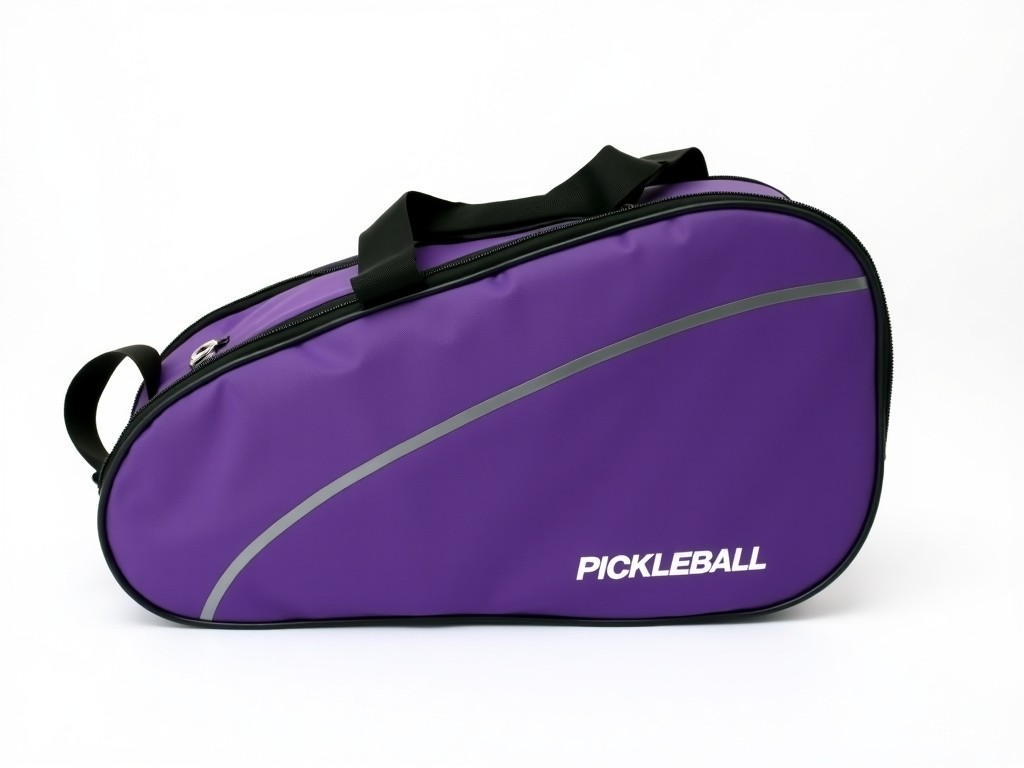
Wholesale Purple Pickleball Carry Bag Factory
A pickleball carry bag is designed to transport paddles, balls, shoes, and accessories while shielding them from impact, moisture, and UV exposure during travel to courts, tournaments, or storage.
Wholesale Purple Pickleball Carry Bag
A pickleball carry bag is designed to transport paddles, balls, shoes, and accessories while shielding them from impact, moisture, and UV exposure during travel to courts, tournaments, or storage.
The typical construction uses 600‑denier polyester yarn woven in a plain weave, coated on the interior with a 0.15 mm PVC layer to achieve water resistance and added abrasion strength, measured at roughly 45 N/mm tensile strength in the warp direction.
- Exterior fabric: 600D polyester, UV‑stabilized to retain color after 200 hours of Xenon arc exposure.
- Interior lining: PVC‑coated polyester, providing a barrier against moisture and preventing interior condensation.
- Reinforced base panel: double‑layer 800D polyester with rubberized corners to resist wear from floor contact.
- Zipper: self‑healing coil type rated for 5,000 cycles, with a pull tab reinforced with bar‑tack stitching.
- Webbing straps: 38 mm polypropylene, tensile strength ≥ 2,200 N, stitched with box‑X pattern for load distribution.
Key Dimensions and Capacity
The main compartment measures approximately 38 cm (L) × 20 cm (W) × 12 cm (D), offering enough volume for two standard paddles, three balls, a towel, and a pair of court shoes. Two interior mesh pockets each sized 10 cm × 12 cm provide separation for small items such as grips or wristbands.
Adjustable shoulder straps extend from 70 cm to 130 cm, allowing the bag to be carried comfortably by users ranging from 150 cm to 190 cm in height. The padded back panel incorporates 8 mm EVA foam to reduce pressure points during extended transport.
Maximum recommended load is 8 kg, based on seam‑strength testing of the primary stitching (minimum 250 N per stitch line) and the load‑bearing capacity of the webbing attachments.
Specification Table
| Attribute | Typical Value / Option |
|---|---|
| Exterior Material | 600D polyester, UV‑stabilized |
| Interior Lining | PVC‑coated polyester, 0.15 mm thickness |
| Main Compartment (L×W×D) | 38 cm × 20 cm × 12 cm |
| Internal Mesh Pockets (each) | 10 cm × 12 cm |
| Strap Length (adjustable) | 70 cm – 130 cm |
| Maximum Load | 8 kg |
| Zipper Type | Self‑healing coil, 5,000‑cycle rating |
| Color Options | Purple (Pantone 2592C) standard; custom colors available on request |
| Customization | Screen printing, embroidery, zipper pull tags, strap length adjustment |
Applications in Pickleball Operations
Teams and clubs use these bags to consolidate equipment for away matches, reducing the risk of lost or damaged paddles during transit. The water‑resistant liner protects contents from rain or court‑side moisture, while the UV‑stable exterior prevents fading when bags are stored in direct sunlight between sessions.
Tournament organizers often distribute branded carry bags to participants as part of player packs; the bag’s dimensions accommodate regulation paddles and the standard ball count, ensuring compliance with equipment‑handling guidelines.
Retailers stock the bags as an accessory line, leveraging the consistent sizing to design shelf displays that hold multiple units without excessive overhang or wasted space.
Customization and Branding Options
Logos can be applied via screen printing on the front panel, with a maximum printable area of 25 cm × 15 cm, or embroidered using a 12 mm thread height for a premium finish. Both methods undergo a wash‑fastness test (ISO 105‑C06) to ensure minimal fading after 20 laundry cycles.
Strap length can be tailored in 5 cm increments to match specific user ergonomics, and interior pocket layouts can be re‑configured upon request to accommodate specialized accessories such as portable scorekeepers or hydration bottles.
Color variations beyond the standard purple are achievable through dye‑lot changes, subject to minimum order quantities of 300 units per shade.
Quality Control Philosophy
Each production lot undergoes seam‑strength verification on a sample of 5 % of bags, using a tensile tester to confirm that stitching meets the 250 N per line benchmark. Zipper functionality is assessed through a cycle tester simulating 5,000 open/close actions, with a pass criterion of no tooth deformation or slider disengagement.
Colorfastness is evaluated by exposing fabric swatches to a Xenon arc lamp for 200 hours, measuring ΔE < 3 against the original purple reference. Water resistance is checked via a spray test (AATCC 22) requiring no interior wet‑through after 5 minutes of 80 mm/hour rainfall simulation.
Final inspection includes a visual check for loose threads, misaligned logos, and proper strap attachment, with a defect threshold set at ≤ 0.5 % for any lot to be cleared for shipment.
Packaging and Logistics
Finished bags are first folded flat, placed in a 50 µm polyethylene bag to guard against dust and moisture during handling. Each polybag is then loaded into a standard export carton measuring 40 cm × 30 cm × 25 cm, with a maximum of 20 units per carton to maintain manageable pallet weight.
Cartons are sealed with pressure‑sensitive tape and stacked on ISO‑standard pallets, corner‑protected with cardboard edge guards to prevent deformation during forklift operations. A typical 20‑ft container holds 1,200 cartons, translating to roughly 24,000 bags.
Shipping documents include a packing list, commercial invoice, and a certificate of conformity confirming compliance with the stated material specifications and safety requirements.
For further details, technical drawings, or to discuss a custom quote, please reach out using the contact form below.
Request a Quote


