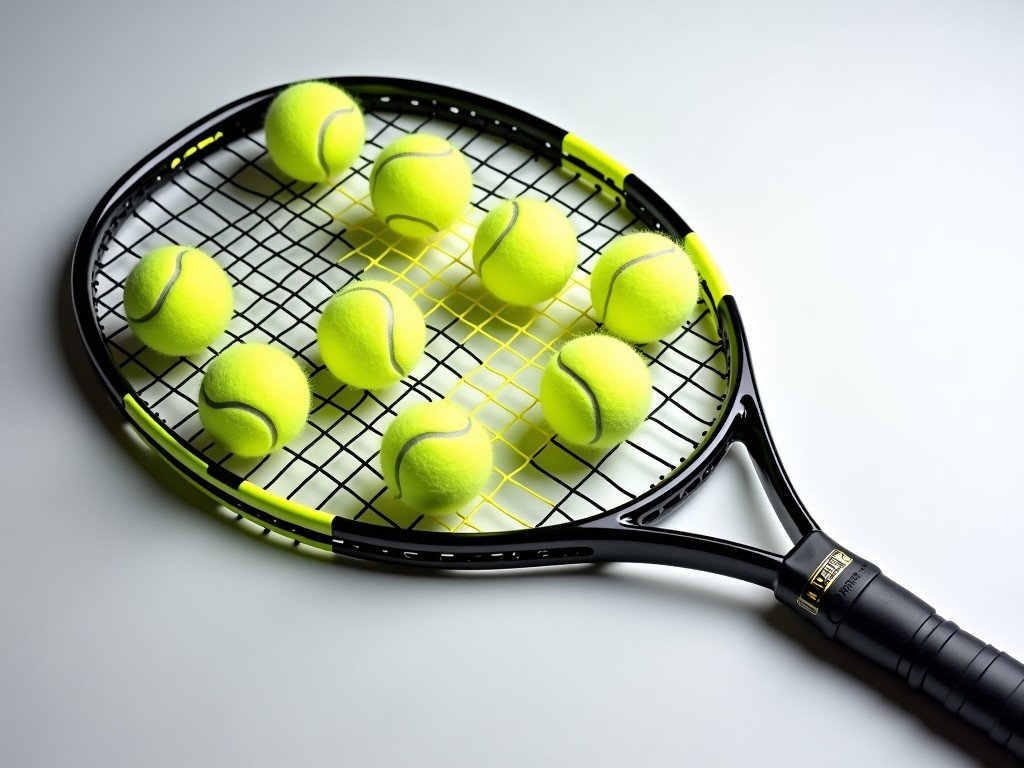
Custom Tennis Racket And Ball Manufacturer
Procurement teams sourcing tennis equipment need confidence that each racket and ball will perform consistently under match conditions. By aligning design variables with measurable engineering
Custom Tennis Racket and Ball Manufacturer
Procurement teams sourcing tennis equipment need confidence that each racket and ball will perform consistently under match conditions. By aligning design variables with measurable engineering criteria, manufacturers can reduce the risk of performance mismatch and extend product lifecycle.
Material Selection for Rackets
Frame stiffness influences power transfer and vibration damping. Commonly used modulus ranges for graphite composites fall between 230 GPa and 260 GPa, while titanium alloys provide a modulus near 110 GPa with higher density. The choice of resin system affects glass transition temperature, typically between 120 °C and 150 °C, which determines heat resistance during stringing.
- High-modulus graphite (≈250 GPa) for low‑mass, high‑stiffness frames.
- Mid-modulus graphite (≈200 GPa) balanced with Kevlar for improved impact toughness.
- Aluminum or titanium alloys for cost‑sensitive frames where weight tolerance is less critical.
- Hybrid lay‑ups combining carbon fiber with basalt to tune damping characteristics.
Racket Geometry Customization
Adjustable parameters allow the racket to match a player’s swing style and court surface. The following variables are typically offered as continuous ranges rather than discrete presets.
- Head size: 85 in² to 110 in², affecting sweet‑spot area.
- Length: 27 in to 29 in, influencing leverage and reach.
- Weight (unstrung): 260 g to 340 g, adjustable in 5 g increments.
- Balance point: 300 mm to 360 mm from butt, selectable for head‑light, even, or head‑biased feel.
- String pattern: 16×19 to 18×20, modifiable to change spin potential and string bed stiffness.
- Beam width: 18 mm to 28 mm, impacting aerodynamics and stiffness.
Ball Specification Options
Ball performance is governed by internal pressure, felt composition, and diameter tolerances. Variations enable optimization for altitude, temperature, and court speed.
- Internal pressure: 1.45 bar to 1.65 bar (measured at 20 °C).
- Diameter: 6.54 mm to 6.86 mm, conforming to ITF limits.
- Felt blend: 68 % wool / 32 % nylon for standard play; higher nylon content for increased durability on hard courts.
- Core material: natural rubber or synthetic elastomers affecting rebound consistency.
Manufacturing Process Overview
Racket production begins with filament winding or prepreg lay‑up on a mandrel, followed by curing in a controlled‑temperature autoclave. Post‑cure machining defines the throat and handle geometry, while drilling and grommet installation prepare the frame for stringing. Ball manufacturing involves molding the core, applying pressurized gas, and bonding the felt cover under heat and pressure.
In‑process monitoring includes laser‑based diameter checks, tension sensors on the stringing line, and pressure gauges for ball cores. These measurements feed statistical process control charts to maintain tight tolerances.
Quality Control and Testing
Finished rackets undergo static flex tests to verify stiffness distribution, and impact tests using a standardized ball at 30 m/s to assess frame durability. Ball lots are checked for rebound height (standardized to 100 cm to 115 cm when dropped from 254 mm) and weight uniformity (±0.5 g).
Each lot receives a unique identifier enabling traceability to raw material batches, curing cycles, and inspection records. This supports warranty claims and continuous improvement.
Typical Applications
Custom rackets are advantageous for junior development programs where progressive weight and balance adjustments support technique refinement. Professional tour players benefit from fine‑tuned swing weight and string bed stiffness to match surface‑specific ball speeds. Clubs and academies ordering balls in bulk can specify pressure settings that compensate for local altitude, ensuring consistent bounce across courts.
Technical Specifications (Typical Values)
| Parameter | Range / Typical Value | Notes |
|---|---|---|
| Frame Material | High‑modulus graphite, titanium alloy, aluminum | Selected per stiffness and weight targets |
| Unstrung Weight | 260 g – 340 g | Adjustable in 5 g increments |
| Balance Point | 300 mm – 360 mm from butt | Head‑light to head‑biased |
| String Tension Range | 20 kg – 30 kg | Dependent on string gauge and pattern |
| Ball Internal Pressure | 1.45 bar – 1.65 bar (20 °C) | Measured with calibrated gauge |
| Ball Diameter | 6.54 mm – 6.86 mm | ITF compliant |
| Ball Weight | 56.0 g – 59.4 g | ±0.5 g tolerance |
Frequently Asked Questions
- Can dimensions be customized? Yes, head size, length, weight, balance, and beam width are adjustable within the ranges shown above.
- What information is required before quotation? Desired weight range, balance preference, string pattern, and any material constraints (e.g., alloy vs. composite). For balls, specify target pressure, felt blend, and quantity.
- What materials are available for racket frames? Standard options include high‑modulus graphite, mid‑modulus graphite/Kevlar hybrids, titanium alloy, and aluminum. Custom lay‑ups are possible upon request.
- How is quality inspected? Each racket undergoes flex and impact testing; each ball lot is measured for rebound height, weight, and pressure. Statistical process control is applied to critical dimensions.
- What packaging methods are available? Rackets are packed in individual foam‑lined cartons with optional moisture‑barrier bags. Balls are packed in pressurized cans or bulk trays with inner liners to maintain pressure.
- How are export shipments protected? Pallets are stabilized with corner braces and stretch film; desiccant packs control humidity for composite frames.
- What is the typical production lead time? Lead time varies from 4 weeks for standard configurations to 8 weeks for fully customized lay‑ups, depending on material availability and tooling.
- How are samples arranged? Sample rackets can be produced with provisional specifications; ball samples are provided in pressurized cans for performance evaluation.
Get a Technical Quote
Share your performance targets and constraints with our engineering team to receive a detailed feasibility study and cost estimate.
Request Quote


