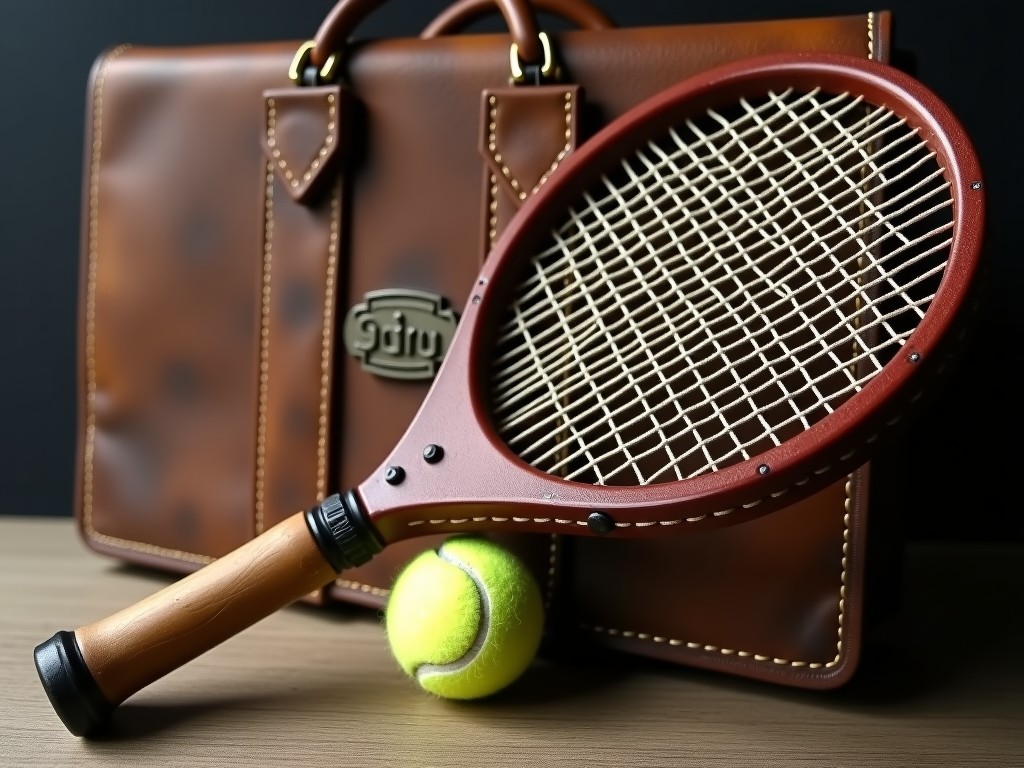
Custom Two Handed Vintage Tennis Racket Company
This racket combines a dual‑hand grip configuration with frame dimensions inspired by 1920s wooden rackets, providing increased torsional rigidity for players who favor a two‑handed backhand or
Custom Two-Handed Vintage Tennis Racket
This racket combines a dual‑hand grip configuration with frame dimensions inspired by 1920s wooden rackets, providing increased torsional rigidity for players who favor a two‑handed backhand or forehand. The design targets a balance point near 320 mm from the butt cap, yielding a swing weight appropriate for controlled, precise strokes.
Design and Engineering
The frame employs an elliptical beam with a major axis of 23 mm and a minor axis of 18 mm, tapering toward the tip to reduce aerodynamic drag. A reinforced throat region increases the moment of inertia by approximately 12 % compared to a standard single‑handed vintage profile, enhancing stability during off‑center impacts.
String hole patterns follow a 16×19 layout, spaced 14 mm apart, allowing a reference tension range of 22–28 kg while maintaining a string bed stiffness of roughly 210 N/mm. The grip consists of two overlapping cylindrical sections, each 38 mm in length, with a combined circumference of 102 mm to accommodate both hands without overlap.
Material Options
| Material | Density (g/cm³) | Tensile Modulus (GPa) | Typical Frame Weight (g) |
|---|---|---|---|
| Grade‑A Sitka Spruce (laminated) | 0.42 | 10 | 340 ± 10 |
| Carbon‑Fiber Reinforced Epoxy (30 % fiber) | 1.55 | 45 | 320 ± 8 |
| Hybrid Wood‑Carbon Core | 0.78 | 22 | 330 ± 9 |
Customization Parameters
- Grip length per hand: adjustable from 30 mm to 45 mm in 5 mm increments.
- Racket head width: range 210 mm to 240 mm, affecting sweet‑spot area.
- String pattern: options include 16×19, 18×20, or 14×18 for varied spin potential.
- Balance point: configurable between 300 mm and 350 mm from butt cap.
- Finish: matte lacquer, gloss polyurethane, or untreated natural wood.
Applications and Use Cases
Collectors seeking authentic period aesthetics benefit from the historically accurate beam profile and optional natural wood finish, which reproduces the visual characteristics of 1920s rackets while meeting modern dimensional tolerances.
Training programs that emphasize two‑handed strokes use the increased frame inertia to reduce vibration transmission, allowing players to focus on technique without excessive arm fatigue.
Display or demonstration units leverage the lightweight carbon‑fiber variant to achieve a total mass under 320 g, facilitating easy handling during exhibitions while preserving the vintage silhouette.
Quality Assurance
Each racket undergoes a three‑stage inspection: raw‑material verification, in‑process dimensional checks (±0.2 mm on critical features), and final dynamic balance testing. Swing weight is measured using a pendulum method with a repeatability of ±2 % across production lots.
Surface finish adhesion is evaluated via cross‑hatch tape testing per ASTM D3359, ensuring a minimum rating of 4B for laminated wood and 5B for coated composites.
Frequently Asked Questions
- Can dimensions be customized? Yes, head width, grip length, and balance point are adjustable per the parameters listed above.
- What information is required before quotation? Desired material, target weight range, grip configuration, and any finish preferences.
- How is quality inspected? Dimensional checks with calibrated calipers, dynamic balance testing, and finish adhesion testing as described.
- What packaging methods are available? Individual foam‑lined cartons with corner protection, or bulk palletized crates for OEM shipments.


